Monday, 7 September 2026

The Sheil Hospital Ballyshannon Lives On


This  is a  tribute to all who played a role in the development of the Sheil Hospital since1894 and who  look forward to the next chapter in a wonderful history. Please share as there is great interest in this Ballyshannon story which is a major part of the regeneration of the area.It is available on my site ballyshannonmusings.blogspot.com for any of your friends who are not on Facebook.
Next Saturday 3rd April sees an unusual blog. "The Curious Case of an Empty Coffin in Ballyshannon"

Dr. Simon Sheil the Founder
Dr.Simon Sheil was the generous philanthropist who left a large sum in his will for the construction of a hospital in Ballyshannon in 1894.The Sheil family were renowned as a medical family for generations and had been in Ballyshannon since the early 19th century. Dr. Simon Sheil qualified as a medical doctor in Edinburgh in 1840 and was appointed a Fellow of the Royal College of Surgeons (F.R.C.S.I.) in 1844. Dr. Sheil practised medicine in Sheil House Ballyshannon during the distressing years of the Great Famine and inherited much of his father’s extensive property. On his own death in 1889 he left endowments in his will which are still providing humanitarian assistance in Ballyshannon today. Dr. Simon Sheil died on the 2nd June 1889 and the distinctive Sheil vault still stands today, in the Abbey graveyard, overlooking the ruins of the Cistercian Abbey of Assaroe. Dr. Simon Sheil’s will was probated on the 1st August 1889. In his will he left £6,000 for the construction of a hospital with an additional £1,000 available as required.
A Hospital for the Wider Community
The hospital served a wide community in South Donegal, North Sligo and North Leitrim. After stipulated endowments in his will, Dr. Sheil left his remaining property in the care of the Sheil Trustees for the erection, maintenance and furnishing of the Sheil Hospital. A management committee for the day to day rules, regulations and ethos of the hospital was to be composed of the following; The Catholic Archbishop of Armagh, Catholic Bishop of Raphoe, Parish Priests of Bundoran and Kilbarron, the County Judge of Ballyshannon, the Protestant rector of Kilbarron and the Chairman of the Ballyshannon Board of Guardians.
Dr. Simon Sheil founder of the hospital

From the Early Days to the Friends of the Sheil Hospital
The Sheil Hospital from the outset was a medical and surgical hospital for the reception of poor patients but with a ward or wards for patients who would be able to pay or contribute towards their support. Architect for the Sheil Hospital was William H. Byrne and the builder was Mr. McAdorey of Dundalk. Looking to the future Dr. Sheil directed that the hospital be built in such a manner that it could easily be added to afterwards. This is currently the situation with the planned extensions in 2021 adding to the original building. The foundation stone for the Sheil Hospital was blessed by Most Rev. Dr. Logue, Primate of All Ireland, and the stone was laid by Ms. Henrietta Sheil in September 1891. She was the last of the family to live in Sheil House on College Street which is currently occupied by Túsla. The role of the Sisters of Mercy has been pivotal in the provision of nursing and administration in the Sheil Hospital and they provided the Matron to the hospital until the early 1990s. The surgeons, doctors nursing and ancillary staff have always provided a professional and caring atmosphere for the patients which is recognised by the wider community .In the 1970s a large extension was added to the hospital with operating theatre, bed lift, children’s ward, female medical ward as well as nursing and domestic staff apartments. The Friends of the Sheil Hospital played an important role in fund-raising for developments such as the new laundry at that period. The Sheil Hospital developed an expertise in surgery and in modern times was recognised for its maternity facilities. In March 1974 the Sheil Hospital was taken over by the North Western Health Board.


Modern Times and a Legacy for the Future
The Health Service Executive’s major building project for the Sheil Hospital, currently under construction, has been welcomed by the entire community and the tireless work of their staff must be acknowledged. Investment in the extension to the hospital will be in the region of €31 million, with the addition of 80 new bed units in a combination of short stay, long stay and dementia wards. The existing buildings at the Sheil Hospital will keep its façade and will also be upgraded. Main contractors for the Sheil Hospital project are Boyle Construction Letterkenny and architects are Rhatigan Architects (Sligo) and Tangram Architects (London). Next door to the Sheil Hospital, the new H.S.E. Primary Health Care Centre has opened and replaced the Convent originally endowed by William Stephens, while also keeping the original facade of the building. Both buildings enhance the built heritage of the town and have their origins in the generous legacies of two Ballyshannon men in the 19th century. Dr. Simon Sheil originally gave an exceptional sum of money for the construction of the Sheil Hospital in 1894 and his legacy to the community will live on, in the much appreciated enhanced developments by the Health Service Executive well into the next century.
Extension to the Sheil Hospital under construction 2021.


Limited edition quality hardback with dust jacket as above available in A Novel Idea and Local Hands Ballyshannon and Four Masters Bookshop Donegal Town. 
Also available signed copies, and inscriptions, for postage or collection from anthonyrbegley@hotmail.com

Topics include: How to go about Tracing your Roots/The first settlers in the area/ Newly researched history of the town of Ballyshannon and the townlands in Kilbarron and Mágh Éne parishes/ Records of the first travellers and tourists to Ballyshannon, Bundoran, Belleek, Rossnowlagh and Ballintra/An aerial guide to place names along the Erne from Ballyshannon to the Bar/Flora and Fauna of the area/  5  Members of Parliament from Ballyshannon/ A history of buildings and housing estates in the locality/Graveyard Inscriptions from the Abbey graveyard, St. Joseph’s and St. Anne’s /Rolling back the years with many memories of the Great Famine, Independence struggle, hydro-electric scheme, Gaelic games, boxing, handball, Boy Scouts, soccer, mummers, characters, organisations, folklore and lots more.

Monday, 13 March 2023

Remembering St. Patrick in Ballyshannon 2023


Rag Tree at St. Patrick's  Well Ballyshannon

Happy St. Patrick's Day 2023 to those at home and away with  Ballyshannon connections or interests. Nostalgic memories today include customs and cures at St. Patrick's Well,  photos of the town band on St. Patrick's Day and remembering the man from California who gave St. Patrick's statue to our town. 

The present St. Patrick's Well in Ballyshannon was opened in 1929 although pilgrims had visited the site to worship for hundreds of years.


"Pray for the Donor" inscription on statue of
St. Patrick. Donor revealed below.

On St. Patrick’s Day 1932 the new statue to St. Patrick was blessed at the Abbey Well by Monsignor McGinley D.D. The statue was donated anonymously.  In 1940 the identity of the donor was revealed when Maurice P. Hayes died in that year at Santa Monica in California. His connection with the Ballyshannon area was through his friendship with William Meehan of Durnish Rossnowlagh and he had acted as executor of his will in 1905. Much later he met Fr. Griffith, a nephew of William Meehan, who was a curate in Ballyshannon. The Hayes family came on a trip to Ireland and met Fr. Griffith in Dublin where he told them of the development of the Abbey Well.  Maurice Hayes gave a gift of the statue of St. Patrick which still stands at the Abbey Well with the inscription; “Pray for the Donor.”  

A station at Ballyshannon's St. Patrick's Well

The Stations at the Abbey Well
Patterns or festivals were celebrated in honour of the patron saint (patrún) of a district or of some saint associated with the area. The pattern at the Abbey Well was held on the Feast of the Assumption on the 15th August each year. It is possible this feast day was chosen because the nearby Abbey of Assaroe was dedicated to Mary. Patterns were important social occasions and, according to tradition, the pattern at the Abbey Well was attended by large crowds up to the nineteenth century with the religious and social events lasting for a few days.
On arrival at the Abbey Well, the pilgrims on some occasions would have Mass celebrated for them, but for the most part they would have performed the station. The station involved reciting set prayers and moving around beds in a similar manner to Lough Derg at the present time. According to folklore the station at the Abbey Well went as follows: Fifteen pebbles were picked from the river bed or station bed and pilgrims began by saying, one Our Father, one Hail Mary and one Creed while kneeling at the well. Then going sun wise they knelt at each bed, saying one Our Father, ten Hail Mary’s and one Creed. A pebble was tossed into each bed. The round of five beds was completed three times and the station was concluded by taking three sips of water from the well and saying a rosary at the grotto.

Rag Tree at St. Patrick's Well

Despite the religious revival in the 1930s and 1940s,  large crowds visiting the Abbey Well gradually waned and nowadays visits to the well are infrequent, except on days like the 15th of August when people still carry on the tradition of visiting the well on the pattern day. 
A feature of the Abbey Well which still attracts great interest from visitors are the rags on the white thorn bushes. Wells were said to have certain cures attached to them and the Abbey Well water was said to be most beneficial for trouble of the eyes. Offerings of coins, medals, flowers and cloth are associated with wells in various parts of the country and the tradition is still practised at the Abbey Well. This tradition of pilgrims with illness or concerns, praying and leaving a piece of cloth on a bush, reminds us that in our modern world there are still echoes of a world which has not fully vanished.

Ballyshannon Brass and Reed Band at St. Patrick's Well in 1947
 Front (l.to r.) Cyril Curran, Leo Masterson (young boy), John McCafferty
 Middle Row: Freddie McDonagh, Patsy O' Donnell, Sean Fox, Jim Dolan,
 P.J. Goan, Tom Gallagher, Jim Gallagher, Jimmy Daly.
 Back Row: Bob Gallagher, Jim Gallagher, James Gallogley, Packie McIvor,
                   Jimmy McNulty, John Davy, Pat McGahern, Seamus Gallagher, Jimmy Coughlin.


Ballyshannon Band at Sligo Parade St. Patrick's ' Day 1979
        Front (l.to r.) Padraig McGarrigle, Danny McGeever, Seamus Gallagher, Bob Gallagher
       Second Row (l.to r.) Jack Grimes, Packie Gallagher, Jimmy Rafferty, Francis Gallagher,
Tom Gallagher, Anthony Begley, James Hoey
            Third Row (l.to r.) Mickie Gallagher, Fergus Lawlor, Michael Dalton, P.J. Goan, Jim Gallagher
   Fourth Row Eamon Gallagher, Cecil Stephens, Michael Gallagher, Eugene McLoughlin
John McGahern.

Band members at St. Patrick's Day Parade Donegal Town 2012
(l.to r.) Danny Carron, Anthony Begley, Tom Gallagher, Michael Donagher

Wednesday, 16 March 2022

Ballyshannon Memories of St. Patrick's Day 2022


Rag Tree at St. Patrick's  Well Ballyshannon

Happy St. Patrick's Day 2022 to those at home and away with  Ballyshannon connections or interests. Nostalgic memories today include customs and cures at St. Patrick's Well,  photos of the town band on St. Patrick's Day and remembering the man from California who gave St. Patrick's statue to our town. 

The present St. Patrick's Well in Ballyshannon was opened in 1929 although pilgrims had visited the site to worship for hundreds of years.


"Pray for the Donor" inscription on statue of
St. Patrick. Donor revealed below.

On St. Patrick’s Day 1932 the new statue to St. Patrick was blessed at the Abbey Well by Monsignor McGinley D.D. The statue was donated anonymously.  In 1940 the identity of the donor was revealed when Maurice P. Hayes died in that year at Santa Monica in California. His connection with the Ballyshannon area was through his friendship with William Meehan of Durnish Rossnowlagh and he had acted as executor of his will in 1905. Much later he met Fr. Griffith, a nephew of William Meehan, who was a curate in Ballyshannon. The Hayes family came on a trip to Ireland and met Fr. Griffith in Dublin where he told them of the development of the Abbey Well.  Maurice Hayes gave a gift of the statue of St. Patrick which still stands at the Abbey Well with the inscription; “Pray for the Donor.”  

A station at Ballyshannon's St. Patrick's Well

The Stations at the Abbey Well
Patterns or festivals were celebrated in honour of the patron saint (patrún) of a district or of some saint associated with the area. The pattern at the Abbey Well was held on the Feast of the Assumption on the 15th August each year. It is possible this feast day was chosen because the nearby Abbey of Assaroe was dedicated to Mary. Patterns were important social occasions and, according to tradition, the pattern at the Abbey Well was attended by large crowds up to the nineteenth century with the religious and social events lasting for a few days.
On arrival at the Abbey Well, the pilgrims on some occasions would have Mass celebrated for them, but for the most part they would have performed the station. The station involved reciting set prayers and moving around beds in a similar manner to Lough Derg at the present time. According to folklore the station at the Abbey Well went as follows: Fifteen pebbles were picked from the river bed or station bed and pilgrims began by saying, one Our Father, one Hail Mary and one Creed while kneeling at the well. Then going sun wise they knelt at each bed, saying one Our Father, ten Hail Mary’s and one Creed. A pebble was tossed into each bed. The round of five beds was completed three times and the station was concluded by taking three sips of water from the well and saying a rosary at the grotto.

Rag Tree at St. Patrick's Well

Despite the religious revival in the 1930s and 1940s,  large crowds visiting the Abbey Well gradually waned and nowadays visits to the well are infrequent, except on days like the 15th of August when people still carry on the tradition of visiting the well on the pattern day. 
A feature of the Abbey Well which still attracts great interest from visitors are the rags on the white thorn bushes. Wells were said to have certain cures attached to them and the Abbey Well water was said to be most beneficial for trouble of the eyes. Offerings of coins, medals, flowers and cloth are associated with wells in various parts of the country and the tradition is still practised at the Abbey Well. This tradition of pilgrims with illness or concerns, praying and leaving a piece of cloth on a bush, reminds us that in our modern world there are still echoes of a world which has not fully vanished.

Ballyshannon Brass and Reed Band at St. Patrick's Well in 1947
               Front (l.to r.) Cyril Curran, Leo Masterson (young boy), John McCafferty
                 Middle Row: Freddie McDonagh, Patsy O' Donnell, Sean Fox, Jim Dolan,
 P.J. Goan, Tom Gallagher, Jim Gallagher, Jimmy Daly.
                   Back Row: Bob Gallagher, Jim Gallagher, James Gallogley, Packie McIvor,
                              Jimmy McNulty, John Davy, Pat McGahern, Seamus Gallagher, Jimmy Coughlin.


Ballyshannon Band at Sligo Parade St. Patrick's ' Day 1979
        Front (l.to r.) Padraig McGarrigle, Danny McGeever, Seamus Gallagher, Bob Gallagher
       Second Row (l.to r.) Jack Grimes, Packie Gallagher, Jimmy Rafferty, Francis Gallagher,
Tom Gallagher, Anthony Begley, James Hoey
            Third Row (l.to r.) Mickie Gallagher, Fergus Lawlor, Michael Dalton, P.J. Goan, Jim Gallagher
   Fourth Row Eamon Gallagher, Cecil Stephens, Michael Gallagher, Eugene McLoughlin
John McGahern.

Band members at St. Patrick's Day Parade Donegal Town 2012
(l.to r.) Danny Carron, Anthony Begley, Tom Gallagher, Michael Donagher


Limited edition quality hardback with dust jacket as above available in A Novel Idea and Local Hands Ballyshannon and Four Masters Bookshop Donegal Town. 
Also available signed copies, and inscriptions, for postage or collection from anthonyrbegley@hotmail.com

Topics include: How to go about Tracing your Roots/The first settlers in the area/ Newly researched history of the town of Ballyshannon and the townlands in Kilbarron and Mágh Éne parishes/ Records of the first travellers and tourists to Ballyshannon, Bundoran, Belleek, Rossnowlagh and Ballintra/An aerial guide to place names along the Erne from Ballyshannon to the Bar/Flora and Fauna of the area/  5  Members of Parliament from Ballyshannon/ A history of buildings and housing estates in the locality/Graveyard Inscriptions from the Abbey graveyard, St. Joseph’s and St. Anne’s /Rolling back the years with many memories of the Great Famine, Independence struggle, hydro-electric scheme, Gaelic games, boxing, handball, Boy Scouts, soccer, mummers, characters, organisations, folklore and lots more.

Thursday, 15 April 2021

On this day 90 years ago a rare event remembered by a Ballyshannon woman.


On this very day 90 years ago a rare memory by a Ballyshannon woman of an event  which will never be repeated in the town. 

 The Mystery of a black coffin solved
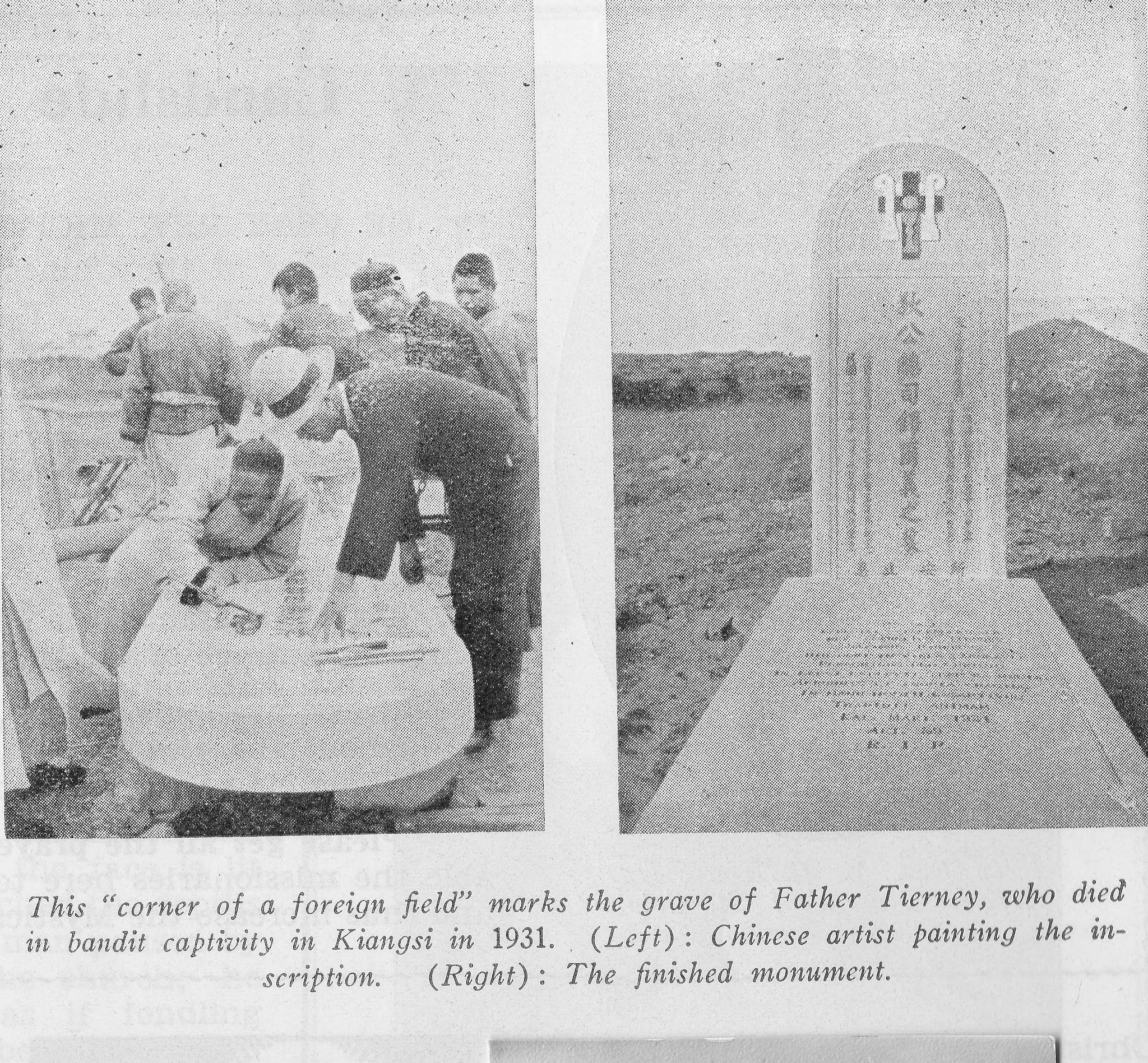
Many years ago a neighbour of mine Brigid Kelly told me that she attended a mass for Fr. Tierney on Wednesday 15th April 1931and that there was a black coffin in the chapel. She had a very keen memory and recalled this solemn event which had a draped coffin in front of the High Altar. This was the first time I had ever heard of a coffin in the chapel with no remains although it may have been familiar to other people. She recalled that there was an air of great sadness in the church and no doubt the coffin in front of the altar added to the touching scene with many in tears. Canon McGrath P.P. Bundoran celebrated the Mass and Monsignor Tierney P.P. Enniskillen presided at the Solemn Office for the Dead with Fr. Timoney from St. Joseph’s as one of the chanters. There were upwards of 40 priests in attendance and some businesses in the town were closed to give employees an opportunity of showing solidarity with this martyred priest. Fr. Tierney is buried in China. 
The  people of Ballyshannon and many from Bundoran, Belleek and outlying districts packed St. Joseph’s Church for a requiem mass in his memory. Fr. Tierney as some will know served in this chapel from 1911-1917 and was very popular with the parishioners many of whom were at this special ceremony. 
Fr. Tierney G.A.A Park in Ballyshannon in memory of this martyred priest.


On the 18th February I posted a blog available in the blog archive at the side of this blog which attracted lots of interest . “From Ballyshannon to China a never forgotten event” told the story of Fr. Tierney who was a priest in the Rock who volunteered to serve in China where he was killed 90 years ago in February 1931. He is buried there but the community in Ballyshannon decided to have a Requiem Mass with a difference in his memory. 

St. Joseph's Church with the Fr. Tierney
Memorial  visible
inside the railing to the left of front door


Today he is remembered by the Aodh Ruadh club who named their football pitch after him and he is also remembered by a memorial at the entrance to St. Joseph’s Church which was erected by Fr. Munster who also served in St. Joseph’s church in recent years. For more information read the blog archive to the right of this article for 18th February 2021.


Memorial to Fr. Tierney in St. Joseph's Church


Limited edition quality hardback with dust jacket as above available in A Novel Idea and Local Hands Ballyshannon and Four Masters Bookshop Donegal Town. 
Also available signed copies, and inscriptions, for postage or collection from anthonyrbegley@hotmail.com

Topics include: How to go about Tracing your Roots/The first settlers in the area/ Newly researched history of the town of Ballyshannon and the townlands in Kilbarron and Mágh Éne parishes/ Records of the first travellers and tourists to Ballyshannon, Bundoran, Belleek, Rossnowlagh and Ballintra/An aerial guide to place names along the Erne from Ballyshannon to the Bar/Flora and Fauna of the area/  5  Members of Parliament from Ballyshannon/ A history of buildings and housing estates in the locality/Graveyard Inscriptions from the Abbey graveyard, St. Joseph’s and St. Anne’s /Rolling back the years with many memories of the Great Famine, Independence struggle, hydro-electric scheme, Gaelic games, boxing, handball, Boy Scouts, soccer, mummers, characters, organisations, folklore and lots more.

Saturday, 3 April 2021

On this day 90 years ago a rare event remembered by a Ballyshannon woman.

Fr. Tierney

On this very day 90 years ago a rare memory by a Ballyshannon woman of an event  which will never be repeated in the town. 

 The Mystery of a black coffin solved
Many years ago a neighbour of mine Brigid Kelly told me that she attended a mass for Fr. Tierney on Wednesday 15th April 1931and that there was a black coffin in the chapel. She had a very keen memory and recalled this solemn event which had a draped coffin in front of the High Altar. This was the first time I had ever heard of a coffin in the chapel with no remains although it may have been familiar to other people. She recalled that there was an air of great sadness in the church and no doubt the coffin in front of the altar added to the touching scene with many in tears. Canon McGrath P.P. Bundoran celebrated the Mass and Monsignor Tierney P.P. Enniskillen presided at the Solemn Office for the Dead with Fr. Timoney from St. Joseph’s as one of the chanters. There were upwards of 40 priests in attendance and some businesses in the town were closed to give employees an opportunity of showing solidarity with this martyred priest. Fr. Tierney is buried in China. 
The  people of Ballyshannon and many from Bundoran, Belleek and outlying districts packed St. Joseph’s Church for a requiem mass in his memory. Fr. Tierney as some will know served in this chapel from 1911-1917 and was very popular with the parishioners many of whom were at this special ceremony. 
Fr. Tierney G.A.A Park in Ballyshannon in memory of this martyred priest.


On the 18th February I posted a blog available in the blog archive at the side of this blog which attracted lots of interest . “From Ballyshannon to China a never forgotten event” told the story of Fr. Tierney who was a priest in the Rock who volunteered to serve in China where he was killed 90 years ago in February 1931. He is buried there but the community in Ballyshannon decided to have a Requiem Mass with a difference in his memory. 

St. Joseph's Church with the Fr. Tierney
Memorial  visible
inside the railing to the left of front door


Today he is remembered by the Aodh Ruadh club who named their football pitch after him and he is also remembered by a memorial at the entrance to St. Joseph’s Church which was erected by Fr. Munster who also served in St. Joseph’s church in recent years. For more information read the blog archive to the right of this article for 18th February 2021.


Memorial to Fr. Tierney in St. Joseph's Church


Limited edition quality hardback with dust jacket as above available in A Novel Idea and Local Hands Ballyshannon and Four Masters Bookshop Donegal Town. 
Also available signed copies, and inscriptions, for postage or collection from anthonyrbegley@hotmail.com

Topics include: How to go about Tracing your Roots/The first settlers in the area/ Newly researched history of the town of Ballyshannon and the townlands in Kilbarron and Mágh Éne parishes/ Records of the first travellers and tourists to Ballyshannon, Bundoran, Belleek, Rossnowlagh and Ballintra/An aerial guide to place names along the Erne from Ballyshannon to the Bar/Flora and Fauna of the area/  5  Members of Parliament from Ballyshannon/ A history of buildings and housing estates in the locality/Graveyard Inscriptions from the Abbey graveyard, St. Joseph’s and St. Anne’s /Rolling back the years with many memories of the Great Famine, Independence struggle, hydro-electric scheme, Gaelic games, boxing, handball, Boy Scouts, soccer, mummers, characters, organisations, folklore and lots more.

Wednesday, 17 March 2021

Ballyshannon Memories on St. Patrick's Day

Rag Tree at St. Patrick's  Well Ballyshannon

Happy St. Patrick's Day to those at home and away with  Ballyshannon connections or interests. Nostalgic memories today include customs and cures at St. Patrick's Well,  photos of the town band on St. Patrick's Day and remembering the man from California who gave St. Patrick's statue to our town. 

The present St. Patrick's Well in Ballyshannon was opened in 1929 although pilgrims had visited the site to worship for hundreds of years.

  
"Pray for the Donor" inscription on statue of
St. Patrick. Donor revealed below.

On St. Patrick’s Day 1932 the new statue to St. Patrick was blessed at the Abbey Well by Monsignor McGinley D.D. The statue was donated anonymously.  In 1940 the identity of the donor was revealed when Maurice P. Hayes died in that year at Santa Monica in California. His connection with the Ballyshannon area was through his friendship with William Meehan of Durnish Rossnowlagh and he had acted as executor of his will in 1905. Much later he met Fr. Griffith, a nephew of William Meehan, who was a curate in Ballyshannon. The Hayes family came on a trip to Ireland and met Fr. Griffith in Dublin where he told them of the development of the Abbey Well.  Maurice Hayes gave a gift of the statue of St. Patrick which still stands at the Abbey Well with the inscription; “Pray for the Donor.”


A station at Ballyshannon's St. Patrick's Well


The Stations at the Abbey Well
Patterns or festivals were celebrated in honour of the patron saint (patrún) of a district or of some saint associated with the area. The pattern at the Abbey Well was held on the Feast of the Assumption on the 15th August each year. It is possible this feast day was chosen because the nearby Abbey of Assaroe was dedicated to Mary. Patterns were important social occasions and, according to tradition, the pattern at the Abbey Well was attended by large crowds up to the nineteenth century with the religious and social events lasting for a few days.
On arrival at the Abbey Well, the pilgrims on some occasions would have Mass celebrated for them, but for the most part they would have performed the station. The station involved reciting set prayers and moving around beds in a similar manner to Lough Derg at the present time. According to folklore the station at the Abbey Well went as follows: Fifteen pebbles were picked from the river bed or station bed and pilgrims began by saying, one Our Father, one Hail Mary and one Creed while kneeling at the well. Then going sun wise they knelt at each bed, saying one Our Father, ten Hail Mary’s and one Creed. A pebble was tossed into each bed. The round of five beds was completed three times and the station was concluded by taking three sips of water from the well and saying a rosary at the grotto

Rag Tree at St. Patrick's Well
Despite the religious revival in the 1930s and 1940s,  large crowds visiting the Abbey Well gradually waned and nowadays visits to the well are infrequent, except on days like the 15th of August when people still carry on the tradition of visiting the well on the pattern day. 
A feature of the Abbey Well which still attracts great interest from visitors are the rags on the white thorn bushes. Wells were said to have certain cures attached to them and the Abbey Well water was said to be most beneficial for trouble of the eyes. Offerings of coins, medals, flowers and cloth are associated with wells in various parts of the country and the tradition is still practised at the Abbey Well. This tradition of pilgrims with illness or concerns, praying and leaving a piece of cloth on a bush, reminds us that in our modern world there are still echoes of a world which has not fully vanished.

Ballyshannon Brass and Reed Band at St. Patrick's Well in 1947
               Front (l.to r.) Cyril Curran, Leo Masterson (young boy), John McCafferty
                 Middle Row: Freddie McDonagh, Patsy O' Donnell, Sean Fox, Jim Dolan,
 P.J. Goan, Tom Gallagher, Jim Gallagher, Jimmy Daly.
                   Back Row: Bob Gallagher, Jim Gallagher, James Gallogley, Packie McIvor,
                              Jimmy McNulty, John Davy, Pat McGahern, Seamus Gallagher, Jimmy Coughlin.


Ballyshannon Band at Sligo Parade St. Patrick's ' Day 1979
        Front (l.to r.) Padraig McGarrigle, Danny McGeever, Seamus Gallagher, Bob Gallagher
       Second Row (l.to r.) Jack Grimes, Packie Gallagher, Jimmy Rafferty, Francis Gallagher,
Tom Gallagher, Anthony Begley, James Hoey
            Third Row (l.to r.) Mickie Gallagher, Fergus Lawlor, Michael Dalton, P.J. Goan, Jim Gallagher
   Fourth Row Eamon Gallagher, Cecil Stephens, Michael Gallagher, Eugene McLoughlin
John McGahern.
Band members at St. Patrick's Day Parade Donegal Town 2012
(l.to r.) Danny Carron, Anthony Begley, Tom Gallagher, Michael Donagher
                         Tom Gallagher is the longest serving member in the  history of the band.


Limited edition quality hardback with dust jacket as above available in A Novel Idea and Local Hands Ballyshannon and 
Four Masters Bookshop Donegal Town. 
Also available signed copies, and inscriptions, for postage or collection from anthonyrbegley@hotmail.com

Topics include: How to go about Tracing your Roots/The first settlers in the area/ Newly researched history of the town of Ballyshannon and the townlands in Kilbarron and Mágh Éne parishes/ Records of the first travellers and tourists to Ballyshannon, Bundoran, Belleek, Rossnowlagh and Ballintra/An aerial guide to place names along the Erne from Ballyshannon to the Bar/Flora and Fauna of the area/  5  Members of Parliament from Ballyshannon/ A history of buildings and housing estates in the locality/Graveyard Inscriptions from the Abbey graveyard, St. Joseph’s and St. Anne’s /Rolling back the years with many memories of the Great Famine, Independence struggle, hydro-electric scheme, Gaelic games, boxing, handball, Boy Scouts, soccer, mummers, characters, organisations, folklore and lots more.