Friday, 16 March 2018

Images of St. Patrick's Well in Ballyshannon for St. Patrick's Day and how the station worked


St. Patrick's grotto at the Abbey Well
One of the stations that pilgrims prayed at


    Gathering water from the well


Tying rags  in an ancient custom
Catsby Cave near St. Patrick's Well  at Ballyshannon

Listening to the history of the Abbey Well with Anthony Begley 
local historian


The station involved reciting set prayers and moving around beds in a similar manner to Lough Derg at the present time. According to folklore the station at the Abbey Well went as follows: Fifteen pebbles were picked from the river bed or station bed and pilgrims began by saying, one Our Father, one Hail Mary and one Creed while kneeling at the well. Then going sun wise they knelt at each bed, saying one Our Father, ten Hail Marys and one Creed. A pebble was tossed into each bed. The round of five beds was completed three times and the station was concluded by taking three sips of water from the well and saying a rosary at the grotto. A rag or a medal was left on the bushes near the well


Rag Tree with the Abbey bay in the background


Happy St. Patrick's Day from Ballyshannon 

The photographs above were taken by Pauline Kilfeather, Coláiste Cholmcille, on a history walk/talk to the Abbey, which  I gave to students  from the local community school .


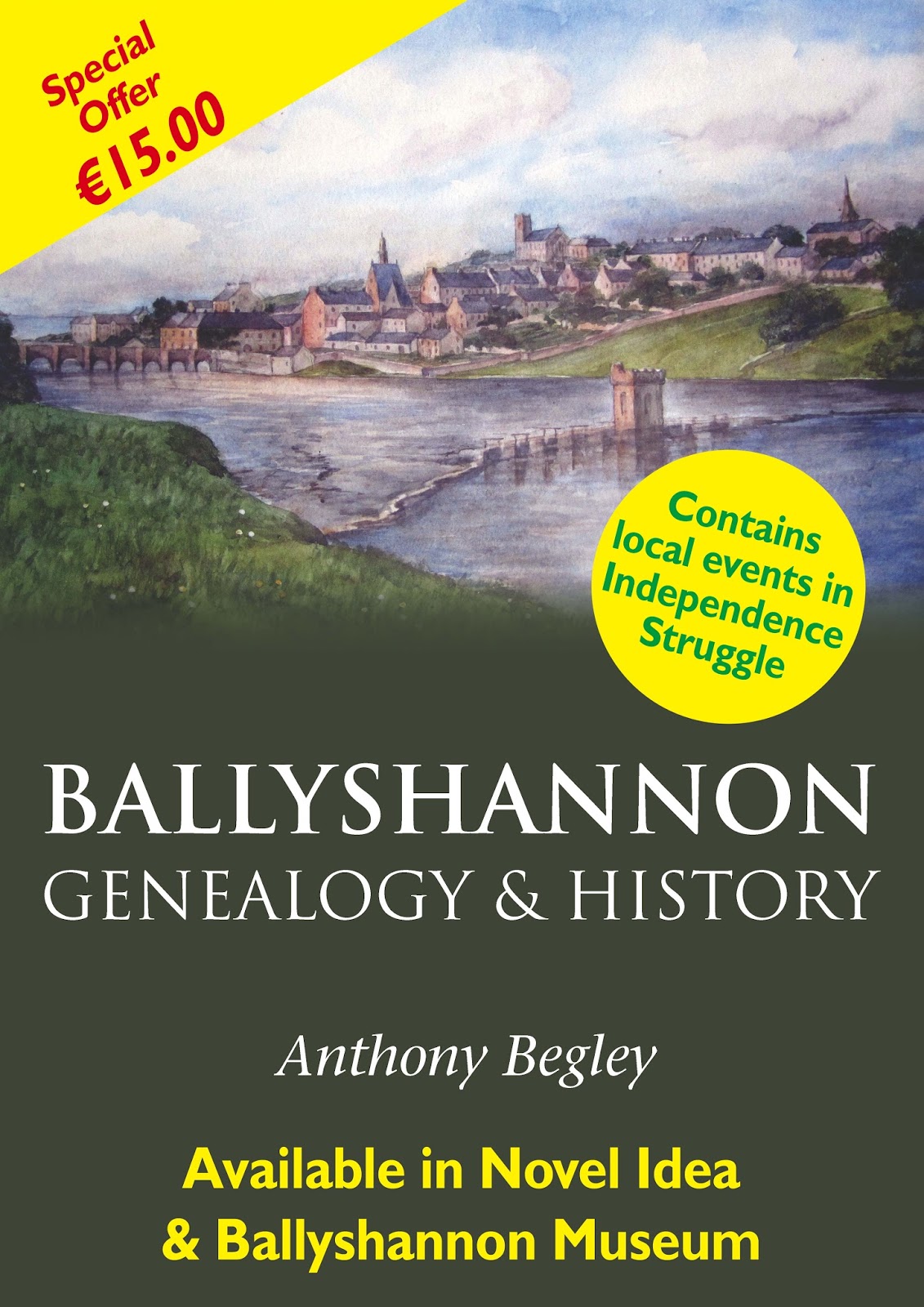
A  Local History Book suitable for those at Home and Away

"Ballyshannon. Genealogy and History" reveals newly researched history and genealogy of the town, extending as far as the Rossnowlagh, Cashelard, Corlea, Clyhore, Higginstown and Finner areas. Includes the parishes of Kilbarron and Magh Ene. It contains the full story of  The Green Lady which  was  performed in Ballyshannon  to great acclaim. The genealogy material provides detailed guidelines for anyone tracing their roots in the area or anywhere in County Donegal or Ireland. The book contains 500 pages and is richly illustrated with stunning colour, aerial photography, original illustrations and rare photographs of the area not seen before. Available in Novel Idea, Museum and Local Hands in Ballyshannon and 4 Masters Bookshop Donegal Town.

Also available from Anthony Begley for postal enquiries email anthonyrbegley@hotmail.com


Saturday, 10 March 2018

On this Pancake Tuesday 25th February 2020 Remembering The Great Snow of 1947 in Ballyshannon


Ballyshannon in the snow  (Andrew Fenton)

The Great Snow of 1947 in Ballyshannon

                                                                             Anthony Begley “Ballyshannon Genealogy and History”

On this day Pancake Tuesday 25th February 2020 remembering the Great Snow of 1947 in Ballyshannon which  left the town and countryside snowbound, on the same day and date Tuesday 25th February 1947.

Snow blizzards gripping the country are well reported in the media and local people look back to previous spells of Arctic weather to compare how people coped with the situation in the Ballyshannon area. Folk memory of the big snow which fell all over Ireland in February 1947 and which resulted in 20-30 days of snowfall between February and March are readily recalled by those who lived through this phenomenon. The snow which fell was of a dry powdery type and driven by an east wind it rapidly covered the landscape and enveloped ditches and electricity poles. Farmers had the added difficulty of foddering cattle and sheep and transport ground to a halt which resulted in continued shortages which followed on from the World War. The cold spell continued into March with Arctic conditions  and snowdrifts causing chaos to people’s lives. The snow was still visible on the mountains near Ballyshannon in the month of May.

The Year of the Big Snow in Ballyshannon 1947- A Lost Car
 Local people can still recall the Big Snow of 1947 when there were immense drifts of snow obliterating pathways, roads and significant landmarks.  In Ballyshannon heavy snow fell for 24 hours commencing on Tuesday 25th of February 1947.On Tuesday transport was able to run  during the day but by nightfall an easterly gale piled the snow into drifts and filled roads and lanes  to hedge-top level. The last bus from Ennniskillen to Ballyshannon was snowbound on Tuesday. The G.N.R. train due in the town at 9 p.m. did not arrive as the line was blocked at Irvinestown. Mr. William Carson, the station master, and his crew, brewed tea for the 20 passengers who were bound for Kesh, Pettigo, Ballyshannon and Bundoran. A coach was specially heated and  the passengers were made comfortable for the night. On Wednesday they got meals in an hotel in Irvinestown and the train then ploughed its way through the drifts reaching Ballyshannon at 7 p.m. on Wednesday. By Wednesday the streets of Ballyshannon were deep in snow and all movement of vehicular traffic ceased.  The only bus to reach Ballyshannon  was the workers bus fromTullaghan driven by Jack McAllister which took four hours and twenty minutes for the short journey. All other traffic into the town from the Sligo direction was hampered when a G.N.R. lorry got stuck in a snow drift near Castegal Post Office. This road remained closed until Friday of that week. Evidence of how deep the snow drifts were revealed in an incident on the Sligo road where a motorist got stuck and went for assistance. On his return he was unable to find the car as it was buried in a snowdrift.

Power Failure and a Novel Way to Deliver Milk
Bread vans were unable to travel but townspeople were fortunate as The Ballyshannon Bakery supplied their needs. Rural milk sellers braved the elements to deliver milk in the town and Mr. Ward of Higginstown had a novel delivery method as he delivered milk with a horse-drawn sleigh. Secondary roads were completely impassible and those who worked in the town  had to pick tracks through the fields. Ballyshannon ground to a halt with the G.N.R. station closed and all work on the Erne Hydro-Electric Scheme ceased. Curiously enough “The Wee Train” as the C.D.R train was called, only lost one hour off its full schedule and was the only lifeline with the outside world. An electrical breakdown at Shannon blacked out the Erne and Abbey Cinema, the Convent and the Sheil Hospital. The old Blackstone generator of the Myles Electrical Works provided the rest of the town with electricity until the E.S.B. resumed service on Thursday. News from the papers and letter communication were hampered by the snow drifts. 

Town Shutdown
One bright spot was that schools were closed and the young and not so young had great fun with snowball fights and sleighing on the peaceful streets of the town. A funeral in the town on Wednesday required six men to carry the coffin with hand slings as it was impossible for the hearse to travel. A local turf lorry had an adventurous journey from Gweedore on Wednesday afternoon as it set out for Ballyshannon at 3 p.m. They dug their way through snow drifts at Doochary and Glenties and eventually made it as far as Ballintra in the early hours of Thursday morning. They encountered their deepest drifts there but eventually made it to Ballyshannon, sleepless,foodless and exhausted at 11 a.m. on Thursday. Train services resumed on Thursday with outstanding mail arriving in town but only the Belfast and Derry newspapers arrived. No bus had arrived from Sligo by Friday. It was hoped to use an Erne bulldozer to clear the streets and gangs of council men were employed to clear the station and the Beleek, Bundoran and Donegal approaches into the town.

 The Winter of 1947 is frequently cited as a landmark event by those who lived through the arctic conditions and hardships of the time.


A Local History book available in a quality limited hardback edition with dustcover as above in : A Novel Idea Bookshop Ballyshannon, Local Hands Ballyshannon and Four Master's Bookshop Donegal Town and for postal delivery contact the author anthonyrbegley@hotmail.com


Saturday, 20 January 2018

On This Day. The Largest Rally ever in Ballyshannon

This man drew the largest crowd ever in Ballyshannon

On this Day 20th-21st January. The largest gathering of people ever to assemble for an event in Ballyshannon. Thousands travelled from neighbouring towns and areas, from Bundoran, from Kinlough, from Pettigo, from Ballintra,  from Rossnowlagh, from Donegal Town, from Belleek and thousands from the Ballyshannon area. What was happening to draw over 20,000 people to town?

The reason for the gathering was to hear the famous Fr. Mathew speak and most importantly to give the people the pledge to stay off alcoholic drink. Fr. Mathew, a Capuchin priest, was invited to give a charity sermon in St. Patrick's church on Wednesday 20th January 1841. He was a household name throughout Ireland, as the great Temperance crusader, and drew large crowds both to the church (a ticket only event) and to the Big Meadow, a short distance away the following day.  Fr. Mathew tackled the great social ill of people drinking too much and travelled the country giving people the pledge to stay off alcohol.

Huge crowds in the Big Meadow and the Church

 It is estimated that upwards of 20,000 people heard Fr. Mathew speak in the church and at the outdoor rally in 'The Big Meadow.' This today is the location of Coláiste Cholmcille the community school.The town band played “See the Conquering Hero Come” and Ballyshannon never witnessed such an influx of people in the days when most people would have walked to the event. The event was also a fundraiser for the building of the new St. Patrick’s Church which had been badly damaged in The Night of the Big Wind in 1839. A well-known Dublin architect, J. B. Kean, prepared the plans and specifications for parish priest, Fr. Cummins, and the building contract for St. Patrick’s Church was granted to Daniel Campbell, Pettigo, who commenced work in 1842. The foundation stone was laid in May 1842 by Rt. Rev. Dr. Mc Gettigan.
Sheil House adjoined St. Patrick’s Church and today is the property of Kilbarron parish and is occupied by the Health Service Executive. The church car park was at one time the beautiful garden of the Sheil family who are still remembered because Simon Sheil left money for the building of the Sheil Hospital. An unusual entry in the diary of Mary Anne Sheil who lived in Sheil House is recorded on the 27th January 1844: “I saw the altar going to the chapel this day. It has been here for nearly two years but now that the windows are in they can bring it home. If we live a short time I dare suppose, we shall see a glorious new one in it”.

Fr. Mathew rally at St. Patrick's Church and The Big Meadow 1841

Those were the days

The Temperance movement was very strong at that time when Fr. Mathew visited Ballyshannon on this day, 20th January and on the following day. On  Easter Monday there was another  great procession of tee-totallers, followed by a mass and later in the year a collection was taken up for Fr. Matthew’s Temperance Crusade. In October 1841 a Temperance gathering in St. Patrick's Church saw around 1,000 people taking the pledge.The promise to stay off drink led to less crime being committed, less poverty and helped to put an end to the savage faction fights which were widespread in this and other parts of the country.


Read about local events in the 1918 Election, the War of Independence,  the Civil War and the Boundary Commission which established the border in "Ballyshannon Genealogy and History". Also includes lots of local history on Kilbarron and Magh Ene areas. Also lots on how to trace your ancestors.


Local History book available in Local Shops. . "Ballyshannon Genealogy and History" available to purchase in The Novel Idea, Ballyshannon Museum, and Local Hands in Ballyshannon. Available also in Four Master's Bookshop in Donegal Town. For postal details contact anthonyrbegley@hotmail.com

Friday, 22 December 2017

A letter to a mother in Ballyshannon, on Christmas Eve, from the trenches in World War One

Letter sent from the trenches in World War One to Erne Street
This is the third in a series of Christmas memories from Ballyshannon. This third local history blog records a letter sent home in from the trenches in World War One to a mother in Ballyshannon. Places named in this blog are Rossnowlagh, Belleek, East Port, Finner, Main Street, Kilbarron, Rathmore, Enniskillen and Finner Camp.
Over 2,000 people worldwide, so far, viewed the Famine blog in which food was taken from a ship in the Channel at Ballyshannon on Christmas Eve. The previous week we heard about what Christmas shopping was like 125 years ago in Ballyshannon. Over 1,700 people worldwide, so far, viewed that blog.
There are lots of other local stories, and lots of rare photographs, in my local history book available in local shops for Christmas.  See details below.


At the outbreak of World War One in 1914, hundreds of local men had enlisted in the British Army at places like Finner Camp, Enniskillen and different places in Ireland. Many who had emigrated to Great Britain, Australia, U.S.A. and Canada joined in their adopted countries. They joined for a variety of reasons including the opportunity to earn a wage, for a sense of adventure and following the advice of political leaders like John Redmond and James Craig. One hundred years later we have an opportunity to read and hear, for the first time, about what life was like in the trenches, how they felt about the war and tragically reports of how some of them died. Over 60 local men died in the First World
Soldiers joining up at Finner Camp 1914


Letter from Patrick McDonagh to his mother on Christmas Eve

Before World War One began, Patrick McDonagh was an instructor in the Irish National Volunteers in his native Ballyshannon and also in the Belleek district. He would have enlisted in the army, on the advice of the Volunteer leader John Redmond. On the outbreak of war  in 1914 he served in the 2nd Division of the 4th Guards Brigade, British Expeditionary Force. He spent Christmas Eve in the trenches on the Western Front from where he wrote a letter home to his mother Bridget McDonagh 94 Erne Street, Ballyshannon.

I received your last letter all right. We spent our Christmas in the trenches, arriving at the firing line on Xmas Eve. I am sure that you all spent a good Xmas. It is hard on us out here, but these things cannot be helped. Hugh Moan is out here and in my Company. He was wounded early in the war and is out again. Paddy Fleming is here too, he came out from London and joined us while we were having the rest. The country is in a terrible state from heavy traffic. Thank God I am living and well and I shall hope to come out safe. I don’t think that the Germans will last much longer, let us hope so anyway. You can send me a tidy little parcel and make it as secure as possible and put my full address on it. Tell Tommy Moan that Hugh is doing fine and that he and I are together. Let me know how you all spent Christmas and tell me all the news. I had a narrow escape on Christmas Day. A German bullet struck the top of my rifle breaking the top off clean and wounding a sergeant behind me in the trench. I am more than lucky when I was not killed at different times. I am writing this letter in the firing line and hope that you will receive it safe. Tell all the people I am asking for them and hope to see them soon again. We have our priest and doctor with us and the wounded are well looked after, every man receiving the Last Rites of the Church. Isn’t that a great blessing? Good-bye and God bless you all and pray for us out here suffering terribly to save our country from ruin.

                                                                                                P. Mc Donagh


World War One postcard sent to Ballyshannon 

Eight Ballyshannon men who died are named on the Thiepval Memorial in France

Patrick’s brother, John McDonagh, was in the 7th Battalion Royal Inniskilling Fusilliers and was killed in action during the Battle of the Somme in 1916. He is remembered on the Thiepval Memorial along with seven other Ballyshannon men, as their bodies were not located. Those named on the Memorial  include; Corporal Patrick Melly, Finner, Sergeant Christopher Laird, Main Street, Private Robert Kearney, Rossnowlagh, Private Patrick Gallagher, Kilbarron, Private Frederick Armstrong, Private John Joseph McShea, Rathmore, and Private Hugh Moan.

Eight Ballyshannon men  remembered on Thiepval Memorial

Hugh Moan who later died at the Somme, is mentioned in the letter from Patrick McDonagh, above, He was also in the Irish Guards and, as indicated above, he was wounded and returned home for a time. During his recuperation in Ballyshannon, he visited his former workplace at “The Donegal Vindicator” newspaper on East Port, where he indicated to the editor that he didn’t think he would be killed by the Germans.
On the 23rd December 1916 Private Hugh Moan was killed in an accidental explosion in the trenches on the Somme -2 days before Christmas.

Ideal Christmas Gift


Local History book available in Local Shops. . "Ballyshannon Genealogy and History" available to purchase in The Novel Idea, Ballyshannon Museum, O'Neills, Clearys and Local Hands in Ballyshannon. Available also in Four Master's Bookshop in Donegal Town. For postal details contact anthonyrbegley@hotmail.com


Friday, 15 December 2017

10. Most Popular Facebook Blog plus 5 Fun Quiz for you. Ballyshannon 130 Years Ago.


16th April 2020. 10th Most Popular Blog Today as voted by Facebook viewers.  Plus 5 Fun Quiz. Have a go at the questions all answers in the blog. Click like when you find the answers. Share.

Fun Quiz. All answers in blog.
1. How many people are sitting on the bridge in the photo?
2. Who had a business where the Bank of Ireland is today?
3. Where was Mary Allingham sent to?
4. What kind of business had Mr. Michael Cassidy? Clue the same business is in the premises today.
5. When was the town clock built?

Friday 17th April 2020 9th Most Popular Blog plus 5 Fun Quiz.


What was Ballyshannon like  130  Years Ago?
  • The town had a distinctive clock on the newly built Belfast Bank which was built in 1878 at a cost of £4,000.  This building later became the Royal Bank. In the 1960s the Royal Bank amalgamated with the Provincial Bank which was next door and the two banks merged into Allied Irish Bank. (A.I.B.) which still operates as a bank today.The building with the clock then became Gallogley's jewellers.  Today it is owned by Eamon McNulty. Good to see the clock restored.
  • There was a Market House close to O'Reilly's Fish Shop. Courts were conducted in the         Market House and there was also a dispensary and social activities in the building. The Market House was tossed  in living memory. This is an open recreation area today used for craft fairs and open air music events.
  • The Workhouse was still operating on the Rock beside the Church. The building still survives today but is in a dangerous condition. Sad.  New memorial to Famine Orphan Girls opened there in 2014.
  • Famine Orphan Girls Memorial erected in 2014 beside the Workhouse

  • The Famine Orphan Girls Memorial 2014 the only one of its type in Ireland, is open at all times to the public, beside the workhouse and just opposite the entry to Fr. Tierney Park. It names and remembers 19 orphan girls shipped to Australia from Ballyshannon Workhouse at the height of the Famine. The girls were from the areas around Ballyshannon including Kinlough, Belleek, Mulleek and the Ballyshannon area. Mary Allingham, a native of Belleek,  was an orphan in Ballyshannon Workhouse and died in Australia just over  100 years ago . Her story was heard on the Joe Duffy Liveline RTE programme in December 2017 during a discussion on remembering victims of the past. 
  • The Great Northern Railway was thriving in Station Road and there were two trains to Dublin daily. The railway arrived in Ballyshannon over 150 years ago in 1867. One hundred and fifty three years ago, this year, the Sisters of Mercy  also arrived in Ballyshannon and are still here today. The G.N.R. railway closed in Ballyshannon 63 years ago in 1957.
  • There were 6 churches open in town- 2 Catholic, 1 Protestant, 1 Presbyterian and 2 Methodist. The second Methodist Church was at the top of the Main Street. Today there are three churches in town. The town has another iconic clock thanks to the St. Anne's community and the peal of the bells is part of Ballyshannon's heritage. The church which is lit up at night is a welcome beacon for people coming home or passing through town.
  • There were 2 Markets every week in the Market Yard on Thursdays and Saturdays where farmers could sell their produce. The car boot sale takes place in the general area today.
  • Fairs were held on the second day of each month. The Harvest Fair was held on the 16th September and was the biggest social gathering of the year. The cattle, horse and pig fairs were held in and  around the Fair Green which today is Allingham Park. Cattle are now sold in the Mart on Station road.
  • The Donegal Independent  on the Mall and The Donegal Vindicator on the Port were two newspapers carrying on the tradition of the oldest newspaper town in County Donegal begun in 1831. The Donegal Democrat (still in existence) was  founded in Ballyshannon in 1919 and was the last paper to be printed in Ballyshannon. 
  • There was a Coastguard Station, a Brewery  and an Excise Office which all harked back to the days of shipping from the Mall Quay in the town. In modern times a micro-brewery has been opened at Dicey Reillys and who can say what other revivals there will be? The Coastguard houses are still visible at West Rock.
  • The Gasworks was the forerunner of electricity and lit the streets of the town from the area now occupied by the handball alley on  the Mall.
  • Like most  towns in Ireland, craft trades have disappeared since 1889 including; tanners, boot and shoemakers, weigh-masters in the Market Yard, saddlers, cart makers, hide and butter merchants and fishing tackle makers. Good to see a number of craft shops and other new business premises  opening in the town in recent years.

Christmas Shopping in Ballyshannon in 1889


Christmas in 1889 saw lots of optimism with many business premises and private residences decorated for the festive season. As you journey through the streets of Ballyshannon in 1889 you can’t help but notice the large number of shops in the main thoroughfares.  There were a lot more shops in 1889 than in 2020  but some shops were smaller, in some cases a front room in a house. For a more complete list of business premises check out The Ulster Directory of 1880 contained in “Ballyshannon Genealogy and History” noted at the end of the article.

Shopping in the Port
In 1889 the Port area in Ballyshannon was a thriving hub of business but alas the street surface left a lot to be desired. The post office and the Vindicator newspaper were on East Port and a host of local business premises were decorated for Christmas. A local correspondent for “The Donegal Vindicator” has left a descriptive account of Christmas shopping  in the busy town of Ballyshannon in 1889, although space prohibited the reporter listing all businesses:

The two Ports, East and West, though somewhat narrow, did their best to enliven the dullness caused by the thick layer of mud always there. At the extreme West Mr. P. Kelly’s premises were tastefully decorated with the orthodox evergreen, Mr. Peter Campbell’s leather warehouse being also tastefully done up.  Mr. J. Gillespie’s grocery establishment was also prettily adorned with evergreen.  At the Bridge end Mr. James Moohan had his extensive premises fancifully festooned, the decorations from lack of window space being principally inside the shop. Down the East Port Mr. Rapmund has expended great taste in ornamentation, as had also Mrs. Breslin, even the Post Office contriving to throw some brightness on its stern official aspect.  Mr. J. Ward’s two establishments were nicely done up, and across the way Mrs. Cunion’s drapery establishment was a glow of everygreen and holly.  Next door the “Vindicator” looked dull, gloomy and forbidding, as befits a Nationalist newspaper office in these days of prison dungeons and removeable law.  Right over the way, however, Mr. William Maguire’s premises made up for the dark spot by a glow of light and colour, set off with holly and evergreens.Mr. James Brown’s shop was very prettily decorated wiith the usual green.  The other shops along the Bridge were all decorated more or less and some of them looked really charming. 
It becomes evident as you follow the reporter through the main thoroughfares of Ballyshannon, how few of the families who ran businesses in 1889 are still in business today. This indicates, as much as anything does, the massive changes which have taken place in the past 130 years. Can you spot any surviving business family in 2020 ?

The Far Side
One of the great mysteries of life in Ballyshannon is, that no matter what side of the river Erne you were living on, you were said by the locals to be from ‘the far side.’ So crossing the bridge we come to the barracks on ‘the far side’ and the shops on the Main Street. The first building on your left is still called the old barracks, although it had not been used by the military since way before the Great Famine of the 1840s. There was another barracks directly opposite where the C.I.E. and Tourist offices are today but it was in ruins when William Allingham was a boy in the 1830s.


A local book for Christmas


So that you can get your bearings in 2020  the old barracks is occupied by Diarmaid Keon (DKP) auctioneers, a computer shop, a music shop and Mr.G's today. The premises of Robert Sweeney listed below were located where the Bank of Ireland is today. P.B. Stephens' ‘emporium’ is where Mary McGuinness has the town’s valuable bookshop called ‘A Novel Idea’. Read on to see the businesses up the town. 


The newspaper correspondent having crossed the 14 -arch bridge  resumed his descriptions of shops commencing at the bottom of the Main Street. The old barracks on the left of the photograph (with 4 windows visible on the side) is the oldest building in Ballyshannon, built in 1700. It is also home to the  two most famous ghost stories in the area. The ghostly Green Lady and the Goblin Child also known as 'the radiant child' both had connections to this barracks. The full story of the Green Lady is contained in "Ballyshannon Genealogy and History".


From the Barracks to the Butchers
Crossing the Erne swollen by recent rains, the first place to catch the eye is Mr. John Cassidy’s licensed premises, and here quite an unusual array of floral decorations were to be seen and next door Mr. Potter had made a pretty show.The premises of Mr. M. Flanagan command attention. They make some thing like a pantomimic transformation scene, and especially after nightfall proved very attractive. Some of the choicest goods in the haberdashery line are here displayed amid a judicious arrangement of evergreens and large featherly plumes of foreign grasses.  When lighted up at night the effect is very pleasing and attractive.  The interior is also redolent of the festive season.The premises of  Mr. Michael  Cassidy, butcher, were also adorned in a most artistic manner. In the “barrack” decorations were necessarily confined to the interior, and Mr. Patterson, the courteous manager, must be complimented on the dazzling appearance presented on entering. Mr. John Stephens’ establishment was also handsomely ‘got up’ with evergreens and holly, not to speak of the tempting array of Christmas goods set off to such advantage.


Up the Main Street
Mr. Robert Sweeney’s large premises were decorated in every corner, and the windows displayed great taste in arrangement and style. Every Christmas novelty in the drapery line was procurrable here.  Mr. McClelland also had his place very beautifully decorated. Only a passing notice can be given to the premises up this fashionable thoroughfare. Mr. Renison’s premises sported a profusion of holly and evergreens, and Mr. Lipsett’s recent battles did not prevent him from flourishing the season’s emblems. Mrs. Mulhern’s premises were tastefully arranged.  Returning down the opposite side the nice arrangement of Messrs. Forde companies premises was noted. Mr. John Daly had an abundant show of evergreen interspersed with his Christmas stock of fancy drapery goods, nor was the boot and shoe department neglected.  Mr. Hegarty’s jewellery establishment also bore  witness to the festive seson in the shape of holly and evergreen.

Castle Street/The Mall and West Port
Crossing over, Mr. P.B. Stephens’ fancy emporium is reached, and a truly dazzling sight meets the gaze.  The variety here ranges from the tiny toy to the choicest article in usefulness.  Noticeable amongst them being the rarest speciments of parian ware from the world renowned Belleek Pottery.  Farther up, the premises of Mr. Edward Stephens are choicely decorated. Floral ornamentations are also seen in the shops of Mr. McNulty, Mr. Mulrine, Mr. C. Campbell, Mr. J. Kelly and Mrs. Gallagher.  It would be impossible to chronicle and comment upon all. Down the Mall the attractive premises of Mr. Trimble are tastefully and elaborately decorated with moustached monkeys, mirth provoking clowns and other appropriate emblems, suitable for the establishment. Though somewhat out of the beaten track the premises of Mr. Myles must not be forgotten.  The decorations were on a fine scale and thoroughly artistic, obtaining no aid, however, from the nature of his goods, ironmongery and such like, being perhaps the most difficult of all to show off with any effect.

Mr. Lipsett’s ‘recent battles’ above refers to a disagreement which he had over the Inspector Martin plaque which can be seen today in St. Anne’s Church. Inspector Martin was killed in Gweedore in 1889 and is buried beside thw entrance porch to St. Anne's Church. Trimble’s on the Mall, named above, were a newspaper family who still print “The Impartial Reporter” in Enniskillen. Ballyshannon had 2 newspaper at the time with McAdam’s Donegal Vindicator on the Port and Trimble’s Donegal Independent its rival on the Mall.

In 1889 few people were seen to be under the influence of alcohol during the festive season and there were no disturbances of any kind. Business premises in the town closed for Christmas Day and St. Stephen’s Day unlike in modern times where the holiday is generally longer for some. 

Modern Ballyshannon


Local History book available in Local Shops or for Postal Delivery. Ideal Christmas Gift. "Ballyshannon Genealogy and History"  softback available to purchase in  A Novel Idea, Ballyshannon and Local Hands in Ballyshannon. Available also in Four Master's Bookshop in Donegal Town. For postal details contact anthonyrbegley@hotmail.com 
A limited edition of hardbacks available in A Novel Idea and from the author. These hardbacks have not been on sale in recent years and have a dust jacket. Ideal Christmas gift for people with connections to the Ballyshannon area.


A Limited Edition hardback-
a rare publication available in a Novel Idea/ Local Hands/ Four Master's and from Anthony Begley. Ideal for Christmas
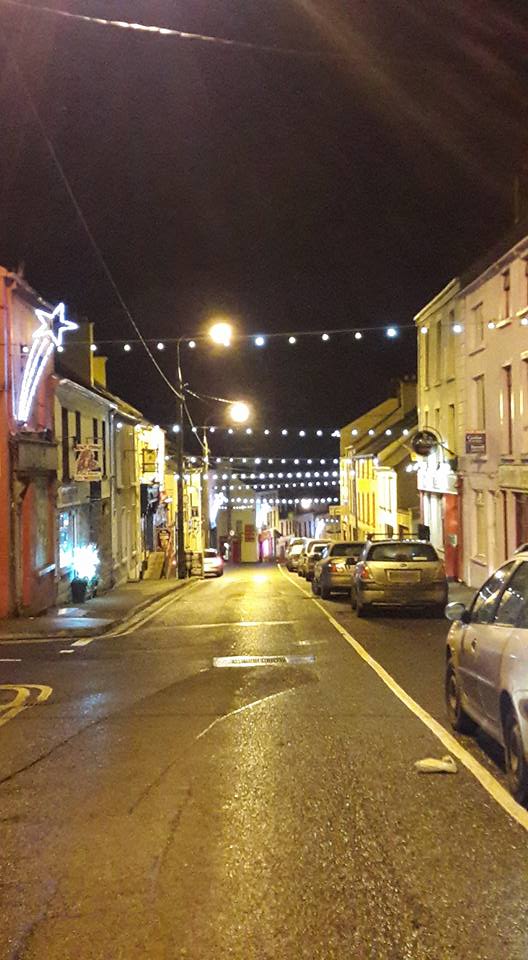
Congratulations to all the business premises who have contributed to the beautiful tree and         the Christmas lighting in the town for many years.

  Rory Gallagher enjoying the Christmas scene
in Ballyshannon

Friday, 8 December 2017

On this day 8th December One of the Orphan Girls who went from Ballyshannon to Australia died


Mary Allingham died on 8th December 1917
On this day 8th December 1917, one hundred years ago, Mary Allingham who had been an orphan in Ballyshannon workhouse died in Australia. Mary Allingham aged 16 was an inmate of Ballyshannon workhouse and her address on the emigration records was given as Billig, Fermanagh which most probably was Belleek, County Fermanagh. The workhouse at Ballyshannon served a wide area, including parts of Fermanagh and Leitrim, and so Mary Allingham would have entered the workhouse at Ballyshannon. Her parents were Robert Allingham and Fanny Marshall (both dead) and by religion were Church of Ireland. She was one of 19 girls who were shipped to Australia from Ballyshannon workhouse at the height of the Famine in 1848.
Mary Allingham in Sydney


The first mention of Mary is in the Bench of Magistrates Cases for Wollombi, a rural area to the north of Sydney.  On 28th July 1849 the Police Magistrate wrote
to Francis Merewether, Immigration Agent, referring him to the enclosed
affidavit relating to the conduct of the employers of Mary Allingham.  The Police Magistrate asked the Immigration
Agent to remove Mary from the service of Mr. John Waugh Drysdale and cancel her
apprenticed articles, and “place her in servitude where her morals and her
religious instruction (she being a member of the Protestant Church of England)
may be attended to; at the same time it may be necessary to mention that four
out of seven of the parties who made the affidavits are of the Roman Catholic
Church”.  Mary’s apprenticeship to the
Drysdales had been made on the recommendation of a Roman Catholic clergyman of
Maitland.

On 3rd September 1849 the Police Magistrate again wrote to the Immigration Agent acknowledging receipt of a Memorandum from the Orphan Immigration Committee.  The Magistrate had the honour to solicit that in consequence of Mary having accompanied her employer Mr. Drysdale to the district of Brisbane Water that he may be excused from proceeding under the Apprenticing Act at his Bench.  He begged leave to recommend that the matter be communicated to the Gosford Bench (Brisbane Water district) that it may give the necessary instructions for the Police to protect “that unfortunate female from being led into scenes of immorality and vice at Mangrove Creek, the present place of residence of Mr. Drysdale.”

On 27th September 1849 the Police Magistrate at Gosford wrote to the Immigration Agent referring to previous correspondence (as above).  The Magistrate reported that they had given their constable at Mangrove Creek express instructions to keep a strick (sic) surveillance over the parties and he had informed them that they have conducted themselves since their arrival in the district with every propriety. He begged to decline entering into any enquiries with the case initiated by the Police Magistrate at Wollombi.

The above account of her employment with John Drysdale reveals that, despite early concerns for her welfare, Mary Allingham continued in his service. The report by the police constable at Mangrove Creek, in September 1849, seems to have put an end to concerns over Mary Allingham’s welfare, as he indicated that there were no grounds for further enquiries.

Marriage of Mary Allingham 1852

Three years after arriving in Australia, on the 2nd August 1852 Mary Allingham was married to John Ellem in the Church of England at Gosford (Mangrove Creek) by Alfred Glennie in the presence of John and Harriett Ferguson of Mangrove Creek. Both John and Mary signed with their mark. John Ellem was a son of Richard Ellem and Charlotte Huxley. They farmed, growing corn and rearing cattle until 1871 when John joined his brothers on the long trek northward to the Clarence River. They raised a family of nine which eventually spread over many of the northern states. 
Mary was described as “very small and thin, about five feet tall, had a fair complexion and extremely red hair”. John Ellem was born on 20th December 1832 and died on the 16th June 1916. Mary Ellem (nee Allingham) died on 8th December 1917 and is buried in the old South Grafton cemetery. Her death certificate stated that her parents were Robert Allingham and Fanny Marshall. Mary Allingham is one of 19 girls remembered at the Orphan Girls memorial beside the workhouse in Ballyshannon. The Orphan Girls Memorial is opposite the Fr. Tierney Park and is open at all times

.Ideal Local Book for Christmas


  "Ballyshannon Genealogy and History" available to purchase in The Novel Idea, Ballyshannon Museum, O'Neills, Clearys and Local Hands in Ballyshannon.Available also in Four Master's Bookshop in Donegal Town. For postal details contact anthonyrbegley@hotmail.com