Tuesday, 9 April 2019

Invitation to the launch of ÓCléirigh School this Friday


All welcome to the launch in the Sandhouse Hotel Rossnowlagh. There will be a number of short presentations and I will be giving one on "Local Links to The Flight of the Earls and the Ulster Plantation". Refreshments served.  Anthony Begley

Wednesday, 3 April 2019

Can you recognise any of the young people in Ballyshannon Band in 1973?

A Junior Band in May 1973 at the Vocational School Sports Day
Great interest in the photo of 40 years ago of  Ballyshannon Brass and Reed Band last week. The Band has attempted to engage young people in band music down through the years.  See how many you can recognise in this appearance 46 years ago! Two of the girls  Geraldine McShea and Geraldine Monaghan were the first girls to play in the Senior Band. There are a number of young people in the band in 2019 but it is a constant struggle as many go away to work or take up other pursuits. 

front (l.tor.) Ann Duffy, Christine Gallagher, Kieran McShea, Thomas Downey, Thomas Gallagher, Terence Lawne.
Middle row (l.tor.) Bernard Monaghan, Patricia Fox, Eleanor McLoughlin, Brenda Fannon, Helen Hoey, Niall Tuohy, Patrick McShane (instructor)
Back row (l.to.r.) Eileen Hoey, Geraldine McShea, Liam Thomas, Pauric McMahon, Geraldine Monaghan and Bernadette Gallagher


A  Local History Book suitable for those at Home and Away

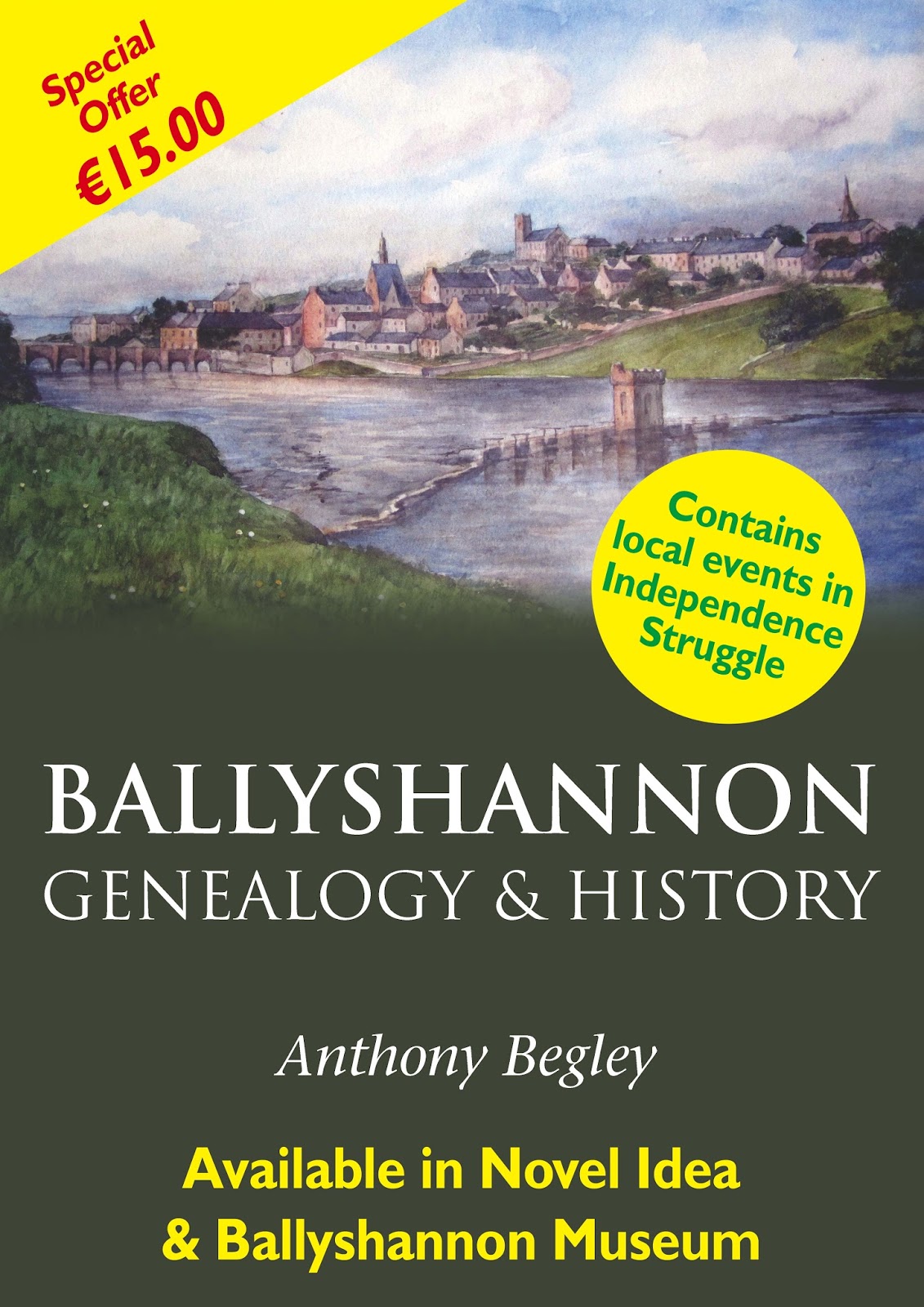
"Ballyshannon. Genealogy and History" reveals newly researched history and genealogy of the town, extending as far as the Rossnowlagh, Cashelard, Corlea, Clyhore, Higginstown and Finner areas. Includes the parishes of Kilbarron and Magh Ene. It contains the full story of  The Green Lady which  was  performed in Ballyshannon  to great acclaim. The genealogy material provides detailed guidelines for anyone tracing their roots in the area or anywhere in County Donegal or Ireland. The book contains 500 pages and is richly illustrated with stunning colour, aerial photography, original illustrations and rare photographs of the area not seen before. 
Available in  A Novel Idea and Local Hands in Ballyshannon and 4 Masters Bookshop Donegal Town. Also available from Anthony Begley for postal enquiries email anthonyrbegley@hotmail.com
Check out lots of local stories by clicking in the blog archive to the right of this post

Saturday, 30 March 2019

40 Years ago the Ballyshannon Band played on

Ballyshannon Brass and Reed Band on St. Patrick's Day 1979 in Sligo
Remembering the Ballyshannon Band of 40 years ago, in its nice new blazers, happy days, good music, absent friends and many family ties. Four of the members of this band still play in Ballyshannon Brass and Reed Band today.  The band has a proud history extending back to playing for Charles Stuart Parnell in the 1880s and is the oldest surviving band in County Donegal. Take a trip down memory lane in this blog.

Front Row: (l.to r.)
Padraig McGarrigle joined the band in De La Salle around 1960
Danny McGeever joined the  band in De La Salle around 1960
Seamus Gallagher (r.i.p.) trombone player whose father Jimmy Gallagher played side-drums in 1929
Bob Gallagher (r.i.p.) played with his brother Jim in the 1940s and their father Jack also played in the band. 

Second Row: (l.to r.)
Jack Grimes (r.i.p.) played cornet in the band
Packie Gallagher (r.i.p.) played alongside his brothers Francis and Tom and Eddie  in the band
Jimmy Rafferty nephew of Seamus Gallagher still plays in the band 
Francis Gallagher (r.i.p.) played side drums like his father Willie Gallagher 
Tom Gallager the longest serving member of the Band who joined in 1943 and played in a group with Danny Gallagher, father of rock musician Rory Gallagher. His children all played in the band.
Anthony Begley joined in De La Salle 1961 and still playing.
James Hoey (r.i.p.) Cornet player and Band leader played with his brothers Bobby and Paddy and his children. James played in the group with Rory Gallagher's father.

Third Row: (l.to r.)
Mickie Gallagher (r.i.p.) a life long and versatile  band member whose sons played in the band.
Fergus Lawlor joined in De La Salle and still playing in the band
Michael Dalton played euphonium in the band 
P.J. Goan (r.i.p.) Considered by many the most talented musician the band produced.
Jim Gallagher (r.i.p.) his father Hughie played in the famous Ballyshannon Band conducted by Mr. Eldon in the early 1900s.

Fourth Row (l.to r.) 
Eamon Gallagher (r.i.p.) followed his father Tommy into the band
Cecil Stephens (r.i.p.) His father was conductor of the band and grandfather a founding member.
Michael Gallagher Band leader today and instructs new members
Eugene McLoughlin (r.i.p.) his son Eugene plays in the band in 2019.
John McGahern (r.i.p.)  Joined the band in De La Salle. The band played recently at John's funeral in 2019. His father Pat and uncle John  played in the band .


A  Local History Book suitable for those at Home and Away

"Ballyshannon. Genealogy and History" reveals newly researched history and genealogy of the town, extending as far as the Rossnowlagh, Cashelard, Corlea, Clyhore, Higginstown and Finner areas. Includes the parishes of Kilbarron and Magh Ene. It contains the full story of  The Green Lady which  was  performed in Ballyshannon  to great acclaim. The genealogy material provides detailed guidelines for anyone tracing their roots in the area or anywhere in County Donegal or Ireland. The book contains 500 pages and is richly illustrated with stunning colour, aerial photography, original illustrations and rare photographs of the area not seen before. 
Available in  A Novel Idea and Local Hands in Ballyshannon and 4 Masters Bookshop Donegal Town. Also available from Anthony Begley for postal enquiries email anthonyrbegley@hotmail.com
Check out lots of local stories by clicking in the blog archive to the right of this post

Saturday, 16 March 2019

St. Patrick's Well in Ballyshannon, the Stations and the Rag Tree on St.Patrick's Day 2019

St. Patrick's grotto at the Abbey Well


One of the stations that pilgrims prayed at


    Gathering water from the well


Tying rags  in an ancient custom
Catsby Cave near St. Patrick's Well  at Ballyshannon

Listening to the history of the Abbey Well with Anthony Begley 
local historian


The station involved reciting set prayers and moving around beds in a similar manner to Lough Derg at the present time. According to folklore the station at the Abbey Well went as follows: Fifteen pebbles were picked from the river bed or station bed and pilgrims began by saying, one Our Father, one Hail Mary and one Creed while kneeling at the well. Then going sun wise they knelt at each bed, saying one Our Father, ten Hail Marys and one Creed. A pebble was tossed into each bed. The round of five beds was completed three times and the station was concluded by taking three sips of water from the well and saying a rosary at the grotto. A rag or a medal was left on the bushes near the well


Rag Tree with the Abbey Bay in the background


The photographs above were taken by Pauline Kilfeather, Coláiste Cholmcille, on a history walk/talk to the Abbey, which  I gave to students  from the local community school .

Happy St. Patrick's Day from Ballyshannon 2019
St. Patrick's Day Parade in Ballyshannon 
Sunday 17th March at 2 p.m.


A  Local History Book suitable for those at Home and Away

"Ballyshannon. Genealogy and History" reveals newly researched history and genealogy of the town, extending as far as the Rossnowlagh, Cashelard, Corlea, Clyhore, Higginstown and Finner areas. Includes the parishes of Kilbarron and Magh Ene. It contains the full story of  The Green Lady which  was  performed in Ballyshannon  to great acclaim. The genealogy material provides detailed guidelines for anyone tracing their roots in the area or anywhere in County Donegal or Ireland. The book contains 500 pages and is richly illustrated with stunning colour, aerial photography, original illustrations and rare photographs of the area not seen before. 
Available in  A Novel Idea and Local Hands in Ballyshannon and 4 Masters Bookshop Donegal Town. Also available from Anthony Begley for postal enquiries email anthonyrbegley@hotmail.com
Check out lots of local stories by clicking in the blog archive to the right of this post


Friday, 8 March 2019

On this day 9th March Falgarragh Park (St. Benildus Avenue) and the East Rock houses were opened in Ballyshannon

Opening of Falgarragh Park (now St. Benildus Avenue) on 9th March 1936. Sean T. O'Kelly,  later President of Ireland , seen here on the right,  under the umbrella,  in the centre, officially opened the housing scheme. Cecil Stephens, Town Clerk, is the man  carrying a folder beside Sean T. Ó Kelly. Dean McGinley P.P Kilbarron  parish is further back under the umbrella.


The second largest housing scheme in the Ulster counties of Cavan, Donegal, and Monaghan was opened at Falgarragh Park Ballyshannon by Sean T.O’Kelly, Minister for Local Government and Public Health  on Monday 9th March 1936. Mr. O’Kelly had played an important role in the 1916 Rising, twenty years before, and was later to become the second President of Ireland. On his visit he firstly inspected the new housing scheme at East Rock which had recently been built on the site of the Rock Barracks. Fr. Timoney blessed the houses and the Minister inspected and complimented the workmanship in their construction. He then visited the Mall Hosiery where the proprietor Mr. Swan presented him with a beautiful cardigan made in the factory. He also visited the Mall Quay and surrounding areas where he praised the new seating, shelter and dance platform recently completed as part of the Town Improvement Scheme. He also visited the Mall Laundry where he was welcomed by the proprietors Mr. & Mrs. M. Ward.
Official Opening of Falgarragh Park (now called St. Benildus Avenue)
At 12.30 Sean T.O’Kelly attended the official opening ceremony of the 80 houses at Falgarragh Park which he described as “the most beautiful he had yet seen”. The Minister remarked on the numbers of houses that needed to be replaced all over Ireland to stop the spread of tuberculosis and infant mortality and welcomed this new housing development in Ballyshannon.  Present with the Minister were local clergy Dean McGinley, Fr. McMullin and Fr. McGroarty who blessed the houses. Also present were Cecil Stephens, Town Clerk, Mr. Lysaght Commissioner in charge of the Town commissioners, M.F. Irwin C.E. Clerk of Works, W.J. Doherty architect of the scheme, reps. of contractor Kilcawley, Maloney and Taylor Ballisadare Co. Sligo, Dr. Gordon, Major Myles T.D. and Brian Brady T.D. The tape of number 77 was then cut by the Minister who inspected the house.

A fuller account of the housing schemes at  Falgarragh,  East Rock , Erne Street, Abbey View Terrace and Cluain Barron are contained in the book “Ballyshannon Genealogy and History” available in local shops. It also contains the biggest housing changes ever in Ballyshannon in the 1930s which I call the Ballyshannon Clearances.  See below for book details. Read also about local incidents in the independence struggle and the forerunner of the backstop in the 1920s,

The following is an extract from a poem which has twelve verses and a number of verses are parodies of William Allingham’s “Adieu to Ballyshanny”. The poem was written by Dan McCauley who had fought in World War 1 and whose family, were one of a number of families, who left condemned houses in places like Bachelor’s Walk and the Back Street to live in the new houses which had all modern amenities.


 The Flight to Falgarragh

‘Twas in an old thatched cabin

With its walls as white as snow,

Where mother dear, (God rest her soul),

Some forty years ago-

Told me of some noble deeds,

How the great Red Hugh did turn

The Saxon from Tirconaill

On the Winding Banks of Erne.


I’ve trod the world ever since,

I’ve ploughed the seas afar,

I’ve seen Killarney’s lakes and fells,

And historic Castlebar.

From County Down to Cavan Town,

Through Fermanagh’s leafy fern,

Till I landed at Falgarragh

On the Winding Banks of Erne.


And now we have a Housing Scheme

To brighten up the town:

We’ll clear out all slum dwellings

And pull the old shacks down,

A brand new house they’re giving us,

              And its Finn Hill turf we’ll burn,

Away in grey Falgarragh

By the Winding Banks of Erne.


"Ballyshannon Genealogy and History" available  in A Novel Idea and Local Hands in Ballyshannon. Available also in Four Master's Bookshop in Donegal Town. For postal details contact anthonyrbegley@hotmail.com


Monday, 11 February 2019

Ballyshannon Town Clock time to restore this landmark


The storm damage in February 2014 to the face of the town clock, pictured above, brings to mind the history of a building which has been a landmark for generations of people who have admired this picturesque building and its chimes. Paddy "Go Aisy" Slevin and his Model T Ford lorry were given the honour of opening the bridge at Ballyshannon, beside the town clock, in the 1940s during the Erne Hydro-Electric Scheme. 
The town clock has an interesting history and is probably the most distinctive and recognisable building in Ballyshannon, for the countless thousands who visit or who pass through the town. Perched at the top of a most impressive Scottish style baronial building built in 1878, the tall two-storey clock and bell tower with crow-stepped gables was built for the Belfast Bank who had commenced business in the town in 1869. The Belfast Bank had close cultural ties with Scotland and the design of this Ballyshannon bank with its tower, gables, bellcotes and clock turret reflects the close ties between Ulster and Scotland. It is estimated that the cost of the building was £4,000. The building later was taken over by the Royal Bank. In the immediate vicinity was the Provincial Bank, the earliest bank in town in 1835, where the poet William Allingham, his father also called William and his brother Hugh, the historian, worked at various periods. Across the street was the National Bank built around 1930, which today is the Bank of Ireland, all three banks were signs of the commercial prosperity of the area. The history of the clock tower recalls an agreement reached between the Belfast Bank and the planning authorities of the day. In return for giving the bank permission to build the bank outwards towards the road, the bank agreed to provide the town with a clock. The date of the erection of the clock, 1878, can be seen from ground level in the stonework just below the recently damaged clock face. 

The immediate area around the clock is one of the most historic in the town with the old customs house just across the street where the Saimer Shopping Centre is today. The site of the town clock was very close to where the "Speaker" Conolly (1662-1729) was born and where his family had a tavern in the 17th century. In sight of the clock tower is the Market Yard where the O’Donnell chieftains had their castle and where in later times the farmers’ markets were held. Across the street was the old military barracks built in 1700 and which stands today as the oldest building in town and the town clock also overlooks the bridge crossing the river Erne. The building ceased operations as a bank when the Royal Bank amalgamated with the Provincial Bank next door and became the Allied Irish Bank around 1966. The Gallogley family who had been in business in the town for generations carried on their clock and jewellery business in the building until very recent times. 
The town has one iconic clock visible from all approaches to the town, thanks to the St. Anne's community, and the peal of the bells is part of Ballyshannon's heritage. The church which is lit up at night is a welcome beacon for people coming home or passing through town. St. Patrick's Church and St. Joseph's Church also have welcoming bells which evoke memories of childhood days. Visitors and local people would like to see the town clock restored.  
Your support for the fundraising concert below would be appreciated on Thursday 21st February at 8.30 p.m. in Dorrian's Hotel. Event organised by Regeneration Group and Ballyshannon Brass and Reed Band.


Monday, 21 January 2019

On This Day. A Ballyshannon woman an eyewitness to the First Dáil


Susan O'Daly an eyewitness to the First Dáil with her husband Cecil Stephens
The fascinating memoirs of a lady who spent the greater part of her life in Ballyshannon, reveal the role played by her, in events in Dublin during the 1916 period and the independence struggle. Susan O’Daly from County Monaghan, as a young student in Dublin, witnessed the immediate aftermath of the 1916 Rising and learned of the execution of one of her teachers, Thomas McDonagh, one of the signatories of the 1916 Proclamation. She acted as a courier during the independence struggle carrying messages to people like Michael Collins and was a classmate of Ernie O’Malley. Susan also took a keen interest in Gaelic culture, was an Irish speaker, and engaged in the politics of the day. In the 1918 Election she canvassed for the Sinn Féin party and was present in the Mansion House for the opening of the First Dáil on the 21st January 1919 and has left her vivid memory of the day. Susan spent most of her life in Ballyshannon with her husband Cecil Stephens and her family.

Susan O’Daly an Eyewitness at The First Dáil 

On the 21st January 1919 the Sinn Féin elected members refused to attend the parliament in Westminster but, instead, declared their independence by meeting in Dublin. This was a challenge to the British government and was also on the day two policemen were shot at Soloheadbeg Co. Tipperary at the beginning of the War of Independence. Susan O’Daly got a pass to witness this historic event and was among the audience, in the Mansion House Round Room, who looked on in some trepidation but with a sense of great pride. She recalled the meeting of the First Dáil in her memoir in 1969 on the 50th anniversary of the first meeting.

“I have a vivid recollection of the whole procedure- Fr. Flanagan began with a prayer. Then the reading of the proclamation in Irish, English and French and on to the roll call every second name called, met with the response “Faoi glas in nGallaibh” (in prison in England) and this rang out through the whole building. I can still hear it! Outside, Dawson Street was packed with people, spilling over into Molesworth Street and St. Stephen’s Green.  On that famous occasion fifty years ago, it was all very different from what one reads in the papers about it. There was a tremendous feeling of exaltation mingled with fear? Nobody knew what might happen, would there be am raid by the military, a stampede, wholesale arrests, shooting? The ‘big shots’ as I call them, were only very ordinary people. They became ‘big shots’ very much later-some of them. Some were afterwards killed by Black and Tans or executed in Mountjoy when the Irish Free State came into existence”.

 Fr. Flanagan, the priest who said the prayer at the beginning of the First Dáil, had been stationed, at an earlier stage, in Cliffoney Co. Sligo, where he championed the people’s right of access to the turf bog which was being denied. Susan recalled that there was a tremendous air of excitement around the meeting of the First Dáil, but this was tinged with fear that there would be a raid by the British military, with perhaps wholesale arrests and shootings.

“I wonder how many in the Round Room and in the streets outside thought the whole performance an act of sheer madness-the idea of defying the might of the British Empire. What reasonable person could think it possible that a Dáil could ever be established! Certainly not in 1919; it just couldn’t happen! But it did!”

On her marriage to Cecil Stephens in 1922 Susan O’Daly devoted her life to family, the business and their shared love of Gaelic culture and music. She would still be remembered by members of the community, as she was engaged in the extensive family hardware and fancy goods business on Castle Street in the town. A teacher by profession, with her commercial training, she was well suited to keeping the financial records for the business. She also established an Argosy lending library in the shop and this was popular with the local population, as they could rent books, at a nominal cost, long before the days of television and public libraries. Her husband Cecil played an active role in the development of the G.A.A, the Gaelic League and was a member of the delegation from Ballyshannon to the Boundary Commission in Enniskillen in 1925. Cecil Stephens was for many years Town Clerk, Conductor of Ballyshannon Brass and Reed Band, Conductor of the local Musical Society and a founder of the Donegal Democrat along with John Downey. Susan and Cecil Stephens had four children; Donal, Nan (Sister Colmcille), Aiden and Cecil. Susan Stephens died on 7th May 1979 and is interred in Abbey Assaroe. Very few outside her family circle knew that Susan Stephens (nee O’Daly) had been in Dublin during the 1916 period and that she had been active in Cumann na mBan, acted as a courier in the War of Independence and was present when the First Dáil met in the Mansion House in Dublin on 21st January 1919.
                        Susan and Cecil Stephens had their business premises where A Novel Idea Bookshop 
is today ( to the right of the group of men)


This book is available in a limited hardback edition with dust jacket  in A Novel Idea Ballyshannon and for postal delivery from Anthony Begley anthonyrbegley@hotmail.com
The book is also available in softback in A Novel Idea, Local Hands  in Ballyshannon and the Four Master's Bookshop Donegal Town. Lots of colour, history and rare photographs of the area from Rossnowlagh to Finner to Belleek and all local townlands