Monday, 4 May 2020

Farewell to Ballyshannon


Monday 4th May 2020. Today  is a memorable story of emigration from the Great Northern Railway station in Ballyshannon.

Farewell to Ballyshannon

 “Farewell to Ballyshannon” is a story which tells of a young local boy called Johnny being accompanied to the Great Northern Railway station in Ballyshannon, by his mother and his sister Susy, on the first stage of his emigration to America. The following is an extract from the story which reveals a continuous process of emigration from the Ballyshannon area and the sadness of those leaving and those left behind. The narrator and a friend were also on the cart to the railway station.
Johnny’s mother accompanied her twelve year old son on the horse and cart from the Main Street to the railway station on Station Road:

“He’s but a little chap to take the green fields to Amerikay alone. Ay surely!” said our carman, musingly. By this time we were rattling down the street, and over the bridge, from which we could see the silver spray of the falls below and hear the dull thunder. The other car was close behind, all the ragged retainers trotting cheerfully in its wake. “Is there much emigration from here?” one of us asked. “Ay surely”, said the man, “what else is there for them? Sure there isn’t enough to keep the life in the old bodies, unless the young goes away to Amerikay, and sends home the money. Och, sure, it’s the sorrowful place. If you was here last Wednesday you’d have seen a trainful starting for Derry. An’ the same every Wednesday since March. I don’t like to be about the station myself them times. It’s terrible hard for them to go.

We asked one or two sympathetic questions. He answered us flicking his whip. “There’s some,” he said, “tht’ll hold up strong and silent; and there’s others again, keenin’ worse than the old women at the wakes. There’s a girl now,” he broke off, pointing at a straight, handsome creature, who was just stepping across the street. “There’s a girl started for Amerikay, an’ kem home the next day. Ay, faith, it was the shortest voyage yet known in the town. She turned back from Derry. She said she didn’t give a thraneen for the passage money. She’d work her fingers to the bone to earn enough to keep the oul’ woman out of the workhouse, without lavin’ her childless. “ He said it with a certain admiration and added immediately afterwards, “ There’s not a handsomer nor cleverer girl than Nancy Goligher in the three baronies.”

Then he planted his feet firmly, as if he had talked enough, and began to sing in a deep baritone:

Farewell to Ballyshanny! where I was bred and born;
Go where I may, I’ll think of you, as sure as night or morn.
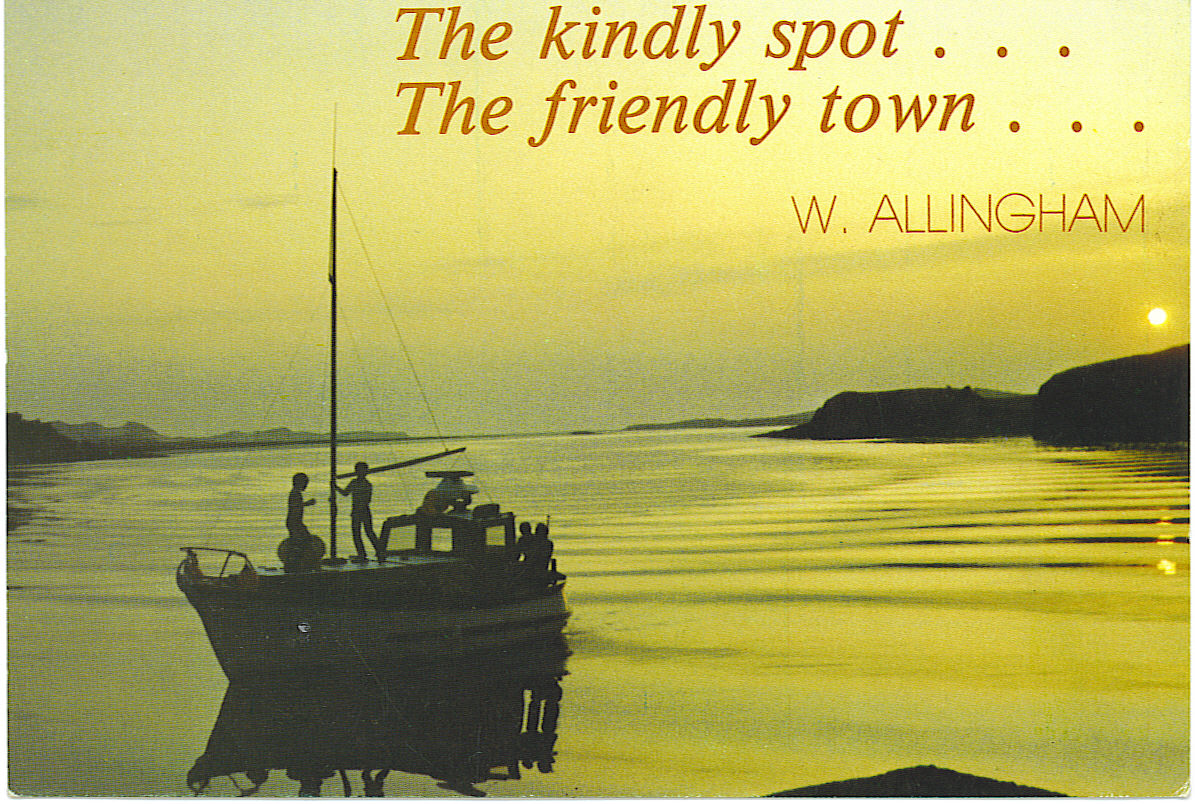
The kindly spot, the friendly town, where every one is known,
And not a face in all the place but partly seems my own;
There’s not a house or window, there’s not a field or hill,
But, east or west, in foreign lands, I’ll recollect them still.
I’ll leave my warm heart with you, Tho my back I’m forced to turn-
So adieu to Ballyashanny, and the winding banks of Erne!

It was the song of a townsman who had won the delightful immortality of being the ballad maker to his birthplace. Under the circumstances the song sounded curiously mournful. William Allingham’s ballad “Adieu To Ballyshanny” must rank as one of the finest and saddest emigration songs of all times.


On arrival at the railway station some of Johnny’s friends came to see him off. The mother explained that he was setting out for Florida to join his father who had been there eleven years. He had been unable to secure work in Ballyshannon. Each year one of the children emigrated to join him in America. Only her self and Susy remained and they would follow on next year, when they could get the fare together. The story concluded with the train ready to pull out and the strains of Allingham’s famous emigrant ballad, “Adieu to Ballyshanny”, are whistled by the young boy who was joining the many people from the locality forced to emigrate by economic necessity.

In 1894 Katherine Tynan, well known novelist and poet, wrote the original story, “Farewell to Ballyshannon” about this young boy’s departure from Ballyshannon.
Limited edition quality hardback with dust jacket as above available when things return to normal in A Novel Idea and Local Hands Ballyshannon and Four Masters Bookshop Donegal Town. Also available for postage from anthonyrbegley@hotmail.com
Topics include: How to go about Tracing your Roots/The first settlers in the area/ Newly researched history of the town of Ballyshannon and the townlands in Kilbarron and Mágh Éne parishes/ Records of the first travellers and tourists to Ballyshannon, Bundoran, Belleek, Rossnowlagh and Ballintra/An aerial guide to place names along the Erne from Ballyshannon to the Bar/Flora and Fauna of the area/ A history of buildings and housing estates in the locality/Graveyard Inscriptions from the Abbey graveyard, St. Joseph’s and St. Anne’s /Rolling back the years with many memories of the Great Famine, Independence struggle, hydro-electric scheme, Gaelic games, boxing, handball, Boy Scouts, soccer, mummers, characters, organisations, folklore and lots more.


Sunday, 3 May 2020

A Ballyshannon Woman's Diary of Happy and Sad Events during the Great Famine


People from the area emigrated from the Mall Quay in Famine Times.

Sunday 3rd May This blog  is based on a Ballyshannon Woman's Diary in the 1840s  and has both happy and sad memories of a period of great distress in the Ballyshannon area and in the country. It was broadcast by me on Sunday Miscellany on RTE national radio about ten years ago. ago. Credit to Soinbhe Lally for her help at the time.

Monday 4th May 2020. Tomorrow's blog  is a memorable story of emigration from the Great Northern Railway station in Ballyshannon which replaced the Mall Quay as the place of emigration for local people.

Some years ago, in Ballyshannon, a dusty bundle of papers was discovered inside an old piano. It was a diary, written by a young Ballyshannon woman, Mary Anne Sheil, during the years 1844 to 1848, a diary that, today, opens a window on to Ballyshannon’s living past.

Mary Anne was a daughter of Doctor Simon Sheil, land agent for the Conolly estates and holder of fishing rights on the river Erne. Her mother, Alicia O’Conor, was sister of the O’Conor Don, and lineal descendant of Roderic, last high king of Ireland. 
Sheil House College Street home of diarist  Mary Anne Sheil
Life in the Big House
The diary begins in 1844 when both parents are already deceased. Mary Anne and her sisters have assumed housekeeping duties for their brother Simon who, like his father, is a doctor. The girls take turns to supervise domestic staff, keep accounts and receive visitors. However life is not all duty and so there are piano lessons with Mr. Walton Roberts from London who also teaches them to dance the polka and the waltz. Old Halloween on the 11th of November, sees the family playing parlour games. Mary Anne records: “Julia, Catherine and I put apple peels over the door. Thady Carmichael came under the first, Owen Kean, the second, and the Rev. Coyle under mine, as if to prove its veracity.”
The Circus in Ballyshannon in Famine times.

The Circus arrives in Ballyshannon 1844
The arrival of the circus on the 1st of July 1844 throws Ballyshannon into a state of excitement. There is a circus parade and Mary Anne finds the scene in front of Sheil House “equal to Donnybrook Fair” with jugglers, tumblers, people riding on stilts, dancers,” and seven pairs of beautiful horses. An announcement that Hughes’s Modern Roman Amphitheatre of Arts is to perform next day at the circus ring on the Mall, and that the largest elephant in the world will be there, prompts Mary Anne and her sisters to bring a small boy for a sneak preview. The diary records “a peep through a keyhole” and a glimpse of the elephant which the small boy “particularly enjoys.” 

Ballyshannon Workhouse entrance building still standing.
Poverty and Emigration  from the Mall Quay
However the 1840s are not only a time for circuses. A visit to the workhouse fills Mary Anne with dismay and she writes, “To the poorhouse we went. Oh! What a misery is in this world. I would pray never to die in a Poorhouse.” She is saddened too by the departure of emigrants and records:
We went to the Dungravin Hills to see the ship sailing off to America with 90 passengers from this town and neighbourhood for the Land of Liberty. They had music, which in some degrees removed the sadness of the scene, as they only played merry airs. Anne Rogers has been in floods of tears all this day after Susan Magrath who is gone.


This is Dungravenen promontory fort from  where people waved farewell to their family and neighbours 
on their journey to the New World. On the left of the photograph is the well-known Buaile Bawns.
Two Wedding Ceremonies
When a suitor enters Mary Anne’s life, she is reluctant to confide in her diary, telling us only that she “forgot to mention a remarkable event of yesterday, which was that Mr. John Allingham of Willybrook House sent us his picture to look at. Mr. J. Allingham surprised me in the garden, where we had a long walk. He said a great deal. I listened and said nothing.”
Mr. Allingham proposed marriage and Mary Anne accepted. He gave his betrothed a present of a starling in a cage and shortly afterwards they were married with two wedding ceremonies, one Catholic and one Protestant because theirs was a mixed marriage. Their four children were born during the terrible Famine years that followed and the young parents were fearful for the health of their babies, especially Alice, the youngest, who had to be vaccinated three times. 

A Window on Life in Ballyshannon in the 19th Century
Mary Anne writes less often in her diary now as family cares take precedence and eventually it comes to an end with the lines:
I should be very fond of this Journal, for often when I have set to it with a heavy heart, I have risen from it quite consoled.
And so our window on mid-nineteenth century Ballyshannon closes. 
I am ever for dear sweet Ireland in general, but Ballyshannon in particular
Mary Anne once wrote, leaving us to wonder whether she had any inkling, as she put pen to paper, that she was bequeathing a valuable historical legacy to her beloved town.


Limited edition quality hardback with dust jacket as above available when things return to normal in A Novel Idea and Local Hands Ballyshannon and Four Masters Bookshop Donegal Town. Also available for postage from anthonyrbegley@hotmail.com

Topics include: How to go about Tracing your Roots/The first settlers in the area/ Newly researched history of the town of Ballyshannon and the townlands in Kilbarron and Mágh Éne parishes/ Records of the first travellers and tourists to Ballyshannon, Bundoran, Belleek, Rossnowlagh and Ballintra/An aerial guide to place names along the Erne from Ballyshannon to the Bar/Flora and Fauna of the area/ A history of buildings and housing estates in the locality/Graveyard Inscriptions from the Abbey graveyard, St. Joseph’s and St. Anne’s /Rolling back the years with many memories of the Great Famine, Independence struggle, hydro-electric scheme, Gaelic games, boxing, handball, Boy Scouts, soccer, mummers, characters, organisations, folklore and lots more.

Saturday, 2 May 2020

Ten Local Visitor Attractions in Bygone Days

Kilbarron Castle (courtesy Kilbarron Heritage Group)
Saturday 2nd May 2020.  Today Rossnowlagh, Ballintra,  Kilbarron, Creevy, Ballyshannon, Bundoran, Kinlough and Belleek (plus photos) feature in a list of 10 attractions for  visitors over 100 year's ago.  
Sunday 3rd May 2020. Tomorrow's blog is based on a Ballyshannon Woman's Diary in the 1840s. It has a Sunday Miscellany piece I broadcast on RTE about ten years ago from the Abbey Arts Centre. 

Two hundred years ago tourism in this region was in its infancy and public transport relied on horse drawn carriages for any serious moving about in the region. Railways did not appear in this area until the Great Northern Railway opened through Ballyshannon, Bundoran and Belleek in 1867. Prior to that only the wealthy and the adventurers explored the area. Below are listed 10 attractions which brought the earliest visitors to this area.

Kilbarron Castle

The Ó Cléirigh Castle located on a majestic site overlooking Donegal Bay was recognized as a significant historical site as it was the home of the Ó Cléirigh (O’Cleary) family who produced Michael Ó Cléirigh principal author of “The Annals of the Four Masters”. Mr. and Mrs. S.C. Hall, renowned travellers, were so taken with the site and spectacular location of the castle, which was in ruins when they visited in 1843, that they included a sketch in their book. In the 19th century it was not on any of the main routes and did not get as many visits as its location merited. The ruins of the castle are well worth a visit today as they are accessible along a panoramic pathway beginning close to Creevy Pier.  On the main road to Rossnowlagh is the easily accesible ruins of their church called Kilbarron Church.
Wardtown Castle a short distance away was built in 1739 and commands a beautiful site overlooking the Erne estuary also featured in some  of the travel writers to the area. Well worth a visit also today as there are impressive ruins and the legend of The Colleen Bawn and the Castle Adventure farm.

Rossnowlagh Beach

 
2.  Rossnowlagh Beach

William Allingham (1824-1889) the Ballyshannon poet mentions Coolmore  in Rossnowlagh and the salted air of the Atlantic where people played in the waves in his poem called “The Winding Banks of Erne” written in the mid-19th century. Early tourists needed to have their own private transport as Rossnowlagh at that time was not serviced by a railway and was not on the direct route from Enniskillen or Derry or Sligo. Families like the Sheils who built the hospital in Ballyshannon had an early holiday home on the ground where the Franciscan Friary is today. It was to be the early 20th century before Rossnowlagh became a popular resort with the arrival of the County Donegal Railway in 1905-1906.  People from Ballyshannon, Donegal Town and further afield were able to travel to the seaside by train and with the arrival of motorised transport Rossnowlagh’s popularity increased with people from Northern Ireland. Creevy also became popular with the arrival of the railway. Rossnowlagh is a jewel in the crown which developed slowly and with its magnificent beach,  described by the author Stephen Gwynn as “exquisite,” will continue to be popular in the future.

3.   Inis Saimer Where Civilisation Began!

According to the legendary accounts written in the early manuscripts Inis Saimer at Ballyshannon was the location of the earliest settlers in Ireland. This small island visible in the aerial photograph is situated beside the Mall Quay and Parthalon and his followers settled here having travelled from the Mediterranean region c. 5,000 years ago. The name of the island is said to be named after a favourite dog of Parthalon’s wife the dog was killed in a fit of jealousy. But that is another story! (See Ballyshannon Genealogy and History below for further details).  In the 18th and 19th centuries the Mall Quay was a hive of industry with salmon fishing, cargo boats, an adjacent distillery and a great view of the Assaroe Falls. Ships plied their trade with England, Scandanavia, France and Russia to name but a few countries. Emigrants began their long journey to the United States of America and Canada from this harbour. Early travellers all visited the Mall Quay and commented on the commercial life of the town which was unfortunately hampered by the silting of sand at the bar which over time prevented ships from entering the harbour.


4.   Fishing on the Erne

The earliest tourists who would have been seen in this area would have been fishermen who fished the Erne which had a national reputation as the finest Salmon River in Ireland. The fishermen added to the local economy as they had to get fishing licences from the Sheil family who lived in College Street in Ballyshannon. (Sheil House still stands today and was known to older residents of the area as the Brothers House where the De La Salle Brothers resided in the 20th century. At present it is occupied by the Health Service Executive). The fishermen also employed local gillies to show them the best fishing haunts, to supply them with flies and bait and to carry their gear. These gentlemen fishermen stayed in local hotels such as Cockburn’s Hotel and  Browne’s Hotel , both on Main Street,where a regular feature on the landscape was the fishing gear drying off in the front of the hotels. Rogan’s Fly Tying craft was famous and this family deserve to be remembered for the international reputation of their fishing flies. Today their premises are occupied by the Credit Union building. Lough Melvin in nearby Co. Leitrim was also popular with fishermen  and continues as a fishing destination today. Belleek also shared in this fishing tourism.
Fairy Bridges painted by Helen Allingham wife of poet William Allingham

 5.  Bundoran and the Fairy Bridges

The earliest visitors to the seaside town of Bundoran were the gentry who rented or built houses and who resided there for the summer season. The visitors came mainly for the health properties associated with the bracing sea breezes and in many senses early Bundoran was seen as a health resort. As the 19th century progressed bathing boxes were to appear on the beaches as swimming became more popular. The modern phenomenon of sunbathing and tanning was not a feature of the early days and indeed a pale complexion was valued more than a ruddy one! Local gentry such as the Allingham’s, Coanes and Sheil family in Ballyshannon rented or owned houses in Bundoran and went to stay there for a month or so at a time. Early travellers were extremely curious about natural phenomena like the Giant’s Causeway, Barnesmore Gap and Bundoran had the natural curiosity of the Fairy Bridges overlooking Tullan strand which was frequently commented on by visitors. Bundoran really took off as a holiday resort with the coming of the Great Northern Railway in 1867.

6.  The Pullens at Ballintra


The river Blackwater flows through the Brownhall estate in Ballintra and frequently disappears underground into a series of caves and rock formations which were a source of great interest to travel writers of the past. Called The Pullens (Pullins) they are a natural creation located a few miles from Ballyshannon. In bygone days Captain Hamilton opened The Pullens on 1st June every year to entertain the public who were invited to visit this series of underground caves and river on his estate at Brownhall. The Pullens was a major attraction as far back as the early 19th century when the first tourists to this region had it on their list of things to see. It helped that it was close to the main route from Sligo to Derry. This custom of opening the Pullens to the public continued into recent times.The estate is owned by the Hamilton family who are still in residence in this private estate today.


7. The Assaroe Waterfall


Travel writers who visited the town of Ballyshannon frequently mentioned the waterfall as the most beautiful and spectacular attraction in the town. This waterfall was a nationally known attraction which was reputed to be one of the finest in Ireland. The local poet William Allingham believed that the waterfall was the heartbeat or sound of the town. Located downstream from the bridge in the centre of town the early writers who explored the hidden Ireland always were impressed by the salmon leaping the falls. This salmon leap drew visitors and locals and was in its day a meeting place for people both for fishing, for relaxation and for conversation at the end of a days work. It was located close to the modern footbridge.


No more on pleasant evenings

We’ll saunter down the Mall,

When the trout is rising to the fly

The salmon to the fall.

One of the great scenes for the early visitors coming in the Belleek road to Ballyshannon was the view of the 14- arched bridge over the winding banks of Erne at Ballyshannon. This view captured the essence of the town with the barracks at the bridge, the eel weir, the town clock, St. Anne’s Church on Mullaghnashee and  St. Patrick’s Church with its impressive architecture. This view is captured on the cover of my book “Ballyshannon Genealogy and History” below which was a painting by local woman Maud Allingham. Fishermen cast their lines from the bridge into the Erne below and there was great excitement and spectator sport when a salmon was hooked and played by the fisherman.

8. Belleek and Castlecaldwell


The Caldwell family built a town house in Ballyshannon in the 18th century where the Saimer Court Shopping Centre is today .Their main place of residence was at Castlecaldwell just beyond Belleek. Richard Twiss visited the Caldwells and stayed for a week in 1775 admiring the setting of one of Ireland’s most beautiful country houses. The following year another famous traveller Sir Arthur Young visited the Caldwells and whilst admiring the beautiful surround felt that the house itself was obscured by trees. The house and lands passed to the Bloomfields who were responsible for the building of the world famous Belleek Pottery. The Pottery commenced in 1858 beside the bridge into the pretty village, overlooked by the splendid falls of Rose Isle. Belleek possessed all the necessary ingredients for a successful pottery including china clay and felspar discovered at Castlecaldwell, great water power and the Great Northern Railway which J.C. Bloomfield promoted. The area also benefitted from the lucrative fishing on the river Erne.


 9. Abbey Assaroe


Abbey Assaroe courtesy Rosemary Downey

“Gray, Gray is Abbey Assaroe by Belashanny town,

 It has neither door nor window the walls are broken down.”


The Cistercian Abbey of Assaroe was built in the 12th century and was located close to the banks of the Abbey River. It overlooked the Erne estuary and was for centuries the centre of education, religion and hospitality in the area. Most early travellers to the area visited the location of the Abbey in the 18th and 19th century but as it was in ruins from the 17th century the verse from William Allingham above written in the mid -19th century could describe their impressions. Nevertheless it is an important historical and religious site and with the grave of the last Abbot who died in the 17th century, the Abbot Quin, still legible in the graveyard is still worth a visit.


10. Lough Melvin


In 1826 correspondents from The London Magazine journeyed to Bundoran. They rose early next morning and after a hearty breakfast made their way to Kinlough. A boat had been provided by the Rev. Mr. Donought who brought his water-dog along to secure their shoot on Lough Melvin:


Beautiful Lough Melve! We were now upon thy wave, where so many a sorrowful hour of my life has been soothed; so many a fair-dream conceived.  We were now in one of thy few sedgy bays, gliding softly along the bull-rushes, our detonators poised and cocked. Suddenly a rustling was heard among the reeds; a mallard rose, and fell at the same instant; the report reverberated from island to island, startling the fowl among the shores. They were seen rising in flocks, and arrowing it along the deep. Two more flappers fell at a second shot, which our dog speedily secured. We continued our course along the reeds, flushed with success, and mute with expectation. Another brace rewarded our search.


They landed on a small island not more than thirty feet in diameter where they viewed the ruins of Ross Castle which tradition said had been built on an artificial island for defence. On the shore opposite the island there were mounds visible where the cattle had been enclosed. On landing to view the ruins of Ross Castle they made a surprising discovery. A large tin boiler was erected on a few stones and a sack of malt was also visible. This was the location of a poteen still. Later as they visited an abbey on another island a boat with two men arrived and they spoke in the ‘native tongue’ to their boatman. They offered the visitors a bottle of their best poteen as a mark of hospitality but also no doubt as hush money so that their still would not be detected. They accepted the offer and their boatman showed them several wreaths of smoke visible on the skyline indicating that poteen was in full production. 
They made their lunch on the holy isle of the monks and fired at ducks from the island.  They later ate the ducks when they returned to their lodgings in Bundoran which was used as a base for fishing on Lough Melvin and the Drowes. Game hunting in the area towards the Leitrim Mountains was also very popular.
Limited edition quality hardback with dust jacket as above available when things return to normal in A Novel Idea and Local Hands Ballyshannon and Four Masters Bookshop Donegal Town. Also available for postage from anthonyrbegley@hotmail.com

Topics include: How to go about Tracing your Roots/The first settlers in the area/ Newly researched history of the town of Ballyshannon and the townlands in Kilbarron and Mágh Éne parishes/ Records of the first travellers and tourists to Ballyshannon, Bundoran, Belleek, Rossnowlagh and Ballintra/An aerial guide to place names along the Erne from Ballyshannon to the Bar/Flora and Fauna of the area/ A history of buildings and housing estates in the locality/Graveyard Inscriptions from the Abbey graveyard, St. Joseph’s and St. Anne’s /Rolling back the years with many memories of the Great Famine, Independence struggle, hydro-electric scheme, Gaelic games, boxing, handball, Boy Scouts, soccer, mummers, characters, organisations, folklore and lots more.


Friday, 1 May 2020

Local Customs for Special Days in the Ballyshannon Area

Friday 1st May 2020.  Remembering  local customs for special days from May Day, Bonfire Night, Halloween, New Year's Day, Lent and a local Wedding Custom.
Saturday 2nd May 2020.  Rossnowlagh, Ballintra,  Kilbarron, Creevy, Ballyshannon, Bundoran, Kinlough and Belleek (plus photos) feature in a list of 10 attractions for  visitors over 100 year's ago.  

People long ago had great faith in customs and traditions which were handed down through the generations. People were also very much in tune with the seasons and had customs to go with particular times of the year. Certain times of the year such as Halloween, Bonfire Night, New Year’s Day and May Day had their own special customs in this area.


New Year’s Day

  • Never pay out money on New Year's Day
  • Water whether dirty or clean or ashes should not be thrown out.
  • The floor should be brushed towards the hearth, not out the door.

Lent

The custom in the 19th century was to have dancers and fiddlers performing in the house on Shrove  Tuesday with neighbors gathering in for the fun before Lent began. The 40 days of Lent were then spent in fasting and prayer as was the custom until recent times.

For St. Patrick's Day people in the Ballyshannon area made crosses which they wore on their garments as far back as the 1840s and probably much earlier. 


May Eve 

  • Yellow flowers like buttercups from the meadows were collected on the eve of May day. They were made into wreaths and hung over doors. These flowers were supposed to bring good luck all the year round to those who passed under them. (A modern version of this custom has, for many years, been carried on by the McNamara family at West Rock who place buttercups. on their neighbours' window sills and doorways. No doubt other areas have similar customs).
  • On the evening before the First of May ashes were put on the doorstep and in the morning, if a footprint was turned inwards in the ashes, it was a sign of a marriage in the house, but if the footprint pointed outwards it was a sign of a death in the house.
  • If you got up before the sun rose on May morning and washed your face in the dew you would be good-looking for the rest of that year.


Bonfire Night

  • The night of St. John’s Day was bonfire night and before leaving the fire the mother followed by the family walked around the fire and said three Our Fathers and three Hail Marys in honour of St. John. The father of the house then put some of the coal in a bucket and dropped one in the cornfield, one in the potato field and so on, to bring good luck to the crop. 
  • Another version of the Bonfire custom was to spread the dying embers on crops for good luck and to drive the cattle through the bonfire.
  • Bonfire night has always been one of the highlights of the year when local communities came together to play and mark the seasons. In June 1844 the people looked forward to bonfire night but the morning was stormy however it calmed down later and there was a beautiful evening. In 1844 Mary Anne Sheil, who lived in College Street, in the house now occupied by the HSE at the entrance to St. Patrick's Church car park, counted 21 bonfires from the skylight window of her home.
In the 1930s there were bonfires all over town in places like Milltown, The Cornmarket, Erne Street, Falgarragh, The Kiln Well, The Rock and the Port.

    Halloween Night

    On Halloween night it was the custom that the girls of the house turned their petticoats inside out and left them in front of the fire. The first man to enter the house turned one of the petticoats. The daughter that the petticoat belonged to would marry that man. 


    Another custom was that after the fire was raked the girls put a bowl of water on the hearth and the first man that moved it was a husband of the girl who had left the water.

    Old Halloween

    This was celebrated on the 11th November in the 19th century. Halloween as we know it was called New Halloween. Parlour games played in Ballyshannon included placing apple peels over the door to see who would come under each family members peel. A future marriage a possibility! 

    A lottery with a difference was also held again with a view to marriage. Names were written down of famous national and well known locals and again great fun  and discussion in seeing what marriage matches it threw up. 

    Straw Boys  (Soinbhe Lally)

    Wedding Custom

     A wedding custom was that on the night of the wedding there nearly always was a dance in the house of the bride. Strawboys came to the house and the bridegroom was supposed to go out and give the boys a treat and some money. Then they went away dancing and singing and wishing the bride and groom luck. 

    The bringing home or the hauling home was another custom with a party for the wedding couple lasting all night.

    Limited edition quality hardback with dust jacket as above available when things return to normal in A Novel Idea and Local Hands Ballyshannon and Four Masters Bookshop Donegal Town. Also available for postage from anthonyrbegley@hotmail.com

    Topics include: How to go about Tracing your Roots/The first settlers in the area/ Newly researched history of the town of Ballyshannon and the townlands in Kilbarron and Mágh Éne parishes/ Records of the first travellers and tourists to Ballyshannon, Bundoran, Belleek, Rossnowlagh and Ballintra/An aerial guide to place names along the Erne from Ballyshannon to the Bar/Flora and Fauna of the area/ A history of buildings and housing estates in the locality/Graveyard Inscriptions from the Abbey graveyard, St. Joseph’s and St. Anne’s /Rolling back the years with many memories of the Great Famine, Independence struggle, hydro-electric scheme, Gaelic games, boxing, handball, Boy Scouts, soccer, mummers, characters, organisations, folklore and lots more.