Tuesday, 20 October 2020

Happy Birthday Tom Gallagher- Memories of the Longest Serving Member of Ballyshannon Brass and Reed Band

H
Ballyshannon Brass and Reed Band 1970  Bundoran Corpus Christi procession
Foreground l.to r.  Liam Hoey, Michael Rafferty
2nd Row: Bob Gallagher, Anthony Begley, Seamus Grimes, Tom Gallagher, James Hoey, Michael Gillespie, Danny McGeever
3rd Row: P.J. Goan, Dessie Flynn, Eamon Gallagher, Thomas McBride, Michael Gallagher, Paddy Monaghan, Seamus Gallagher, Mickie Gallagher.

Ballyshannon Brass and Reed Band at St. Patrick's Well 1947
Front Row l.tor. Cyril Curran, Leo Masterson (young boy), John McCafferty
Middle Row: Freddie McDonagh, Patsy O'Donnell, Sean Fox, Jim Dolan, P.J. Goan, Tom Gallagher, Jim Gallagher, Jimmy Daly
Back Row: Bob Gallagher, Jim Gallagher, James Gallogley, Packie McIvor, Jimmy McNulty, John Davy, Pat McGahern, Seamus Gallagher and Jimmy Coughlin

Ballyshannon Brass and Reed Band at St. Patrick's Day Parade Sligo 1979
FRont l.to r. Padraig McGarrigle, Danny McGeever, Seamus Gallagher, Bob Gallagher
Second Row. Jack Grimes, Packie Gallagher, Jimmy Rafferty, Francis Gallagher, Tom Gallagher, Anthony Begley, James Hoey
Third Row. Mickie Gallagher, Fergus Lawlor, Michael Dalton, P.J. Goan, Jim Gallagher
Fourth Row. Eamon Gallagher, Cecil Stephens, Michael Gallagher, Eugene McLoughlin and John McGahern

Happy Birthday Tom on behalf of all the members of Ballyshannon Brass and Reed Band. Thank you for all you did for the band in your 77 years as a playing member. Well done in following a family tradition of service to the Band. Best wishes to Angela and all the family on this special birthday.

Friday, 9 October 2020

8th Anniversary of Ballyshannon Musings this week. Read The Most Popular Local History Blog in the Past 8 Years

The sandbar at Ballyshannon was changed completely by the storm on "The Night of the Big Wind"

To mark the 8th anniversary of the Ballyshannon Musings local history blog this is the most popular blog since it started on 11th October 2012. The Night of the Big Wind left a trail of destruction in Ballyshannon, Bundoran, Rossnowlagh and elsewhere which was the greatest storm recorded in this area. 

All the  Ballyshannon Musings local history blogs since 2012 can be found on ballyshannon-musings.blogspot.com and also on my Facebook page and on Ballyshannon Genealogy and History Facebook page. Please share with anyone interested or with anyone not on Facebook who can find the blogs on blogspot above. There have been nearly 250,000 hits or viewings worldwide of Ballyshannon Musings since 2012. Thanks to all who view and share, for their encouragement and interest in the Ballyshannon area and its history.

The Night of the Big Wind

This was Ireland’s most famous storm and locally it did a lot of damage in the Ballyshannon, Bundoran and Rossnowlagh areas. After a calm day on Sunday 6th January 1839 which was dull, cold, with snow showers, the winds started to pick up on Sunday evening. A westerly gale got stronger by midnight and there were hurricane force winds between 2 and 4 o’clock on Monday morning. As the storm took place in darkness it was more frightening for local people.  Nationwide  the depression and the hurricane force winds were raging until things started to calm down around 5 a.m.
Oíche na Gaoithe Móire as it was called in Irish was used as a point of reference in 1909 when the old age pension was introduced. People who could prove they were over the age of 70 were entitled to a yearly pension of £13. Many people had no written evidence of their age as record keeping was not always the best. If a person could prove that they remembered or were around on the Night of the Big Wind then they got the pension.
 
Rossnowlagh suffered great damage on The Night of the Big Wind 

In the Ballyshannon area the frightening cholera epidemic raged in 1832, followed by the destruction to property caused by the Great Wind in 1839 and the 1840s brought the Great Famine. Small wonder that people at the time felt that the end of the world was near. Two of the churches in Ballyshannon, St. Anne’s and St. Patrick’s had to be rebuilt as a result of the storm. Surviving records only focus on buildings like churches but the damage to private property and agriculture was also very severe. In Bundoran the bathing boxes were nearly all blown down or unroofed. Several private residences were also severely damaged. The “The Derry Journal” gave a report on local conditions:
We have not heard of any lives (man or beast) being lost in the town. The country was not so fortunate----several families buried beneath the ruins of their dwellings. Along the sea coast the destruction of property is melancholy.


Bathing boxes destroyed at Bundoran in Night of the Big Wind


St. Anne’s Church on Mullaghnashee had to be replaced

This church stands on the highest ground in Ballyshannon, overlooking the channel from which the hurricane force winds battered the building. The building was so badly damaged that it was beyond repair. Curiously the only part of the church that was salvaged was the tower (on which there is a clock today). The tower belongs to the earlier church which had been built in 1735. Church services had to be held elsewhere as the huge task of building a new church began. The new church was built speedily by 1841 at a cost of roughly £3,500.  This new building was attached to the original tower, but the new building was wider than the building destroyed on the Night of the Big Wind. This meant that some tombstones had to be removed and a visit to the inside of the church today, reveals two plaques on the south facing wall which refer to this. A plaque to the Allingham family and one to the Major family who would have resided at Camlin, mentions that the people named were buried underneath the new church walls.
     St. Anne's Church  without the clock was rebuilt after damage
caused by The Night of the Big Wind.

St. Patrick’s Church had to be rebuilt 
The roof of St. Patrick’s Church on Chapel Street was very badly damaged and this church was rebuilt with the foundation stone laid in 1842 by Rt. Rev. Dr. McGettigan, three years after the Night of the Big Wind. Daniel Campbell from Pettigo built the new church at a cost of £1,380 with additional costs to window glazers and other sub-contractors. Amongst the fund-raising for the new church was the visit to “The Big Meadow” by Fr. Matthew the great Temperance crusader who drew an estimate crowd of 20,000 to the church and “The Big Meadow”. Even before the Night of the Big Wind, Fr. Cummins P.P. had started to fundraise to rebuild the church which had been built on the site in 1795. The church was in a poor state and undoubtedly the Night of the Big Wind made matters worse and speeded up the building of the present church. Colaiste Cholmcille is now on the site of "The Big Meadow"

St. Patrick's Church had to be rebuilt after the storm
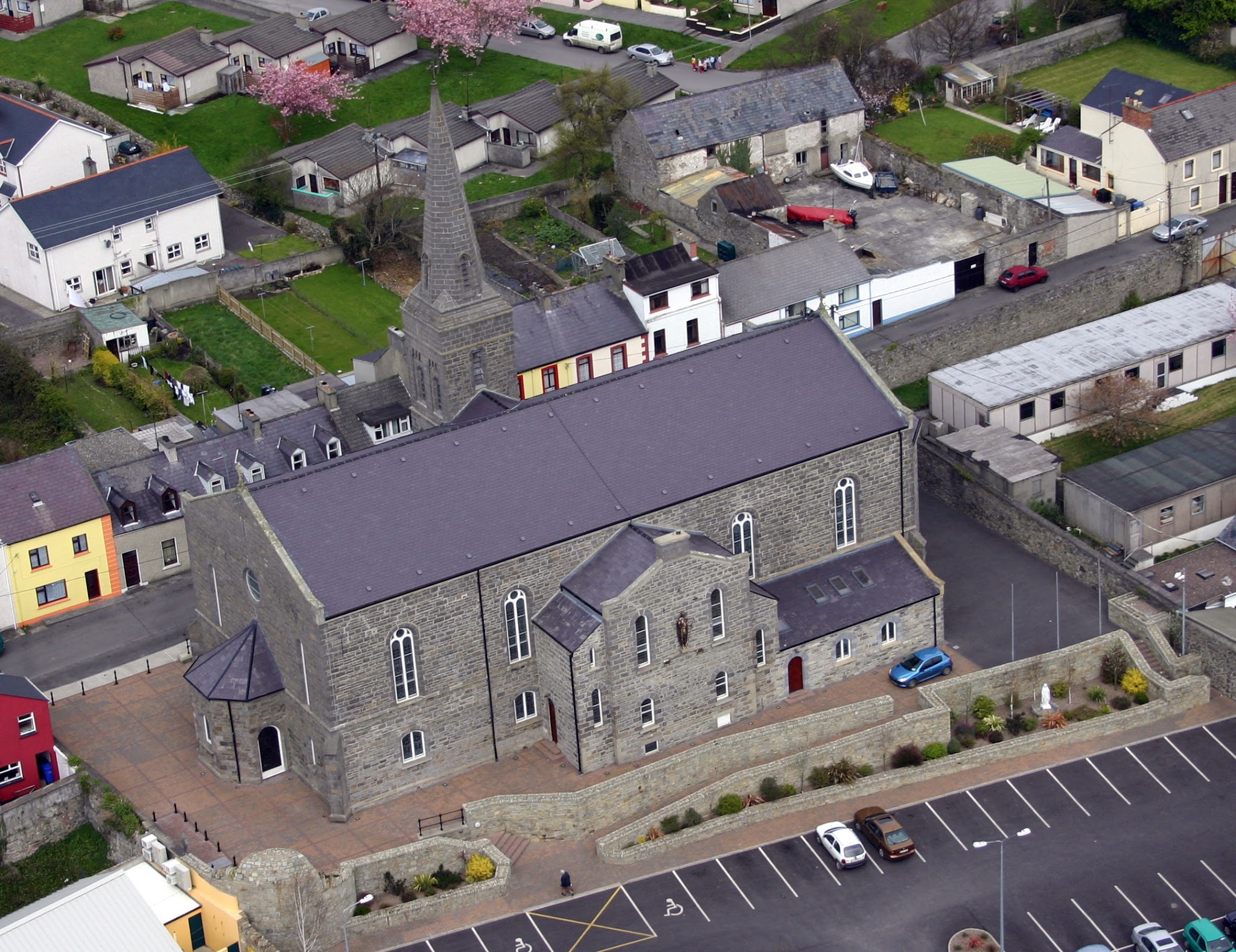
St. Joseph’s Church Damaged/The Methodist Preaching House on the Mall damaged
St. Joseph’s Church on the Rock which had only been built in 1835 suffered much damage and this must have been disheartening to the congregation as they had raised funds for the new building just four years earlier. All this destruction and rebuilding came just as the Great Famine was about to begin in 1844. The present Methodist Church on the Mall (now houses a veterinary practise) was built in 1899 and so the building damaged on The Night of the Big Wind, the Methodist Preaching House on the Mall , was an earlier building.
  
          St. Joseph's Church was only built 4 years when it was badly
                      damaged in the Night of the Big Wind.

The End of the World feared

On the sandbanks at the bar in Ballyshannon, because of the great movement of sand, the banks were the lowest they had ever been. Boats could now pass to areas where the tide had not reached before. Indeed boats could reach areas a half a mile from where they had ever been before. The shifting of sand saw immense volumes blown nearly two miles up to the town of Ballyshannon. Cartloads of sand could be gathered in the immediate vicinity of the town. At Bundoran the bathing boxes were nearly all blown down or unroofed.  In the countryside any hay or grain was destroyed and this led to a crisis in fodder for animals and anxiety over how people would survive.

The sea rose to such a height from Bundoran to Rossnowlagh and Coolmore that people did feel that the end was nigh. Houses and barns were torn down and in the  Rossnowlagh-Coolmore areas there was scarcely a house left standing. Local people in Bundoran, Rossnowlagh and Ballyshannon feared that the hurricane was a sign that the end of the world was near. This was a natural enough reaction to the fiercest storm in living memory and the fears of people who found it  hard to understand. 


Limited edition quality hardback with dust jacket as above available in A Novel Idea and Local Hands Ballyshannon and 
Four Masters Bookshop Donegal Town. Also available signed copies, and inscriptions, for postage or collection from anthonyrbegley@hotmail.com

Topics include: How to go about Tracing your Roots/The first settlers in the area/ Newly researched history of the town of Ballyshannon and the townlands in Kilbarron and Mágh Éne parishes/ Records of the first travellers and tourists to Ballyshannon, Bundoran, Belleek, Rossnowlagh and Ballintra/An aerial guide to place names along the Erne from Ballyshannon to the Bar/Flora and Fauna of the area/ A history of buildings and housing estates in the locality/Graveyard Inscriptions from the Abbey graveyard, St. Joseph’s and St. Anne’s /Rolling back the years with many memories of the Great Famine, Independence struggle, hydro-electric scheme, Gaelic games, boxing, handball, Boy Scouts, soccer, mummers, characters, organisations, folklore and lots more.


Saturday, 3 October 2020

Remembering Ballyshannon a Town with 3 Cinemas! Those Were the Days.

Check out what films were showing this week in October 75 years ago in the Rock Cinema

Seventy five years ago the Cinema was the biggest all year round entertainment attraction in Ballyshannon. It is amazing to recall that there were 3 cinemas in town in the pre-television and pre-computer age. Check out what films were showing on this week in October 1945. The most popular film of the month would take many people by surprise today. Those were the days when the community went to the pictures regularly.

"Casablanca" and "Song of Bernadette"

The big films in  October 1945 were "Casablanca" which ran for 3 nights and "The Song of Bernadette" which ran for 6 nights. Normal admission prices were 1 shilling and four pence for the balcony which was a raised platform at the back of the hall, 9 pence and 4 pence. Children under 14 were not admitted to any late night performances under any circumstances.


"The Song of Bernadette" was the most popular film of the month of October and reflected the importance of religion at the time in the lives of the local people. It ran for 6 nights and the admission prices were increased. The film played to packed houses. Sundays were by far the most popular day for films with 3 showings at 3 p.m. 7 p.m. and 9.15 p.m. A shorter film was played before the main feature film and on October 4th the shorter film was on the inauguration of the President of Ireland. This would have been of special interest to locals as Sean T. O' Kelly the new President had opened the houses at East Rock and Falgarragh Park back in 1936. Many locals would have seen him in person at that stage. 

The First Cinemas-The Market Yard, The Rock, The Erne and The Abbey


  The Rock Hall today. In the cinema days the ticket hatch
was on the front of the building facing the road.

The Rock Hall as well as being a concert venue in the town was also the location of the town’s first permanent cinema. Films were shown earlier in venues, like the eggshed which was located in the centre of the Market Yard, by travelling film companies. The first cinema in town with projection equipment installed was the Rock Hall. John Sweeny of the Commercial Hotel, Major Myles, Paddy Crose and a few interested business people formed the Ballyshannon Cinema Company. They brought in an operator from Glasgow and the cinema played to packed houses, for some years, as people came to the Rock Hall from far and near. During the War of Independence the  Bracey Daniel’s Picture Company booked the Rock Hall annually at Easter and showed silent movies nightly. Bracey Daniels (1884-1956) is buried in St. Joseph’s cemetery close to the Rock Hall and is described on his gravestone as an “Irish Cinema Pioneer”.

By the 1930s the four penny matinee on a Sunday was the highlight of the week for young people in Ballyshannon. Mass in the morning and the ‘flicks’ in the afternoon with the Cisco Kid, Tom Mix, Buck Rogers, Hopalong Cassidy, Roy Rogers and  Dale Evans. The patrons crammed into the hall, sitting on wooden benches, no backs, no arms and noisily greeted their heroes on screen in the ‘talkies’ which had replaced the silent movies. The arrival of the Erne Hydro-Electric Scheme brought great changes to cinema viewing in the town.

     The Abbey Arts Centre today is the focal point for arts events in
                     Ballyshannon. It opened as the Abbey Cinema in 1946. 
 (Image courtesy of Ailis McIntyre Abbey Arts Centre)

By 1946 two new cinemas opened in the town, The Abbey Cinema and the Erne Cinema

The former Erne Cinema today. The entrance was on West Port
just under the canopy where there is a window now.

During the Erne hydro-Electric Scheme in the 1940s the Erne Cinema was constructed beside the river Erne and was a massive attraction as it could hold hundreds of patrons. Today it is a shell of a building used as part of the Centra store.


 The former Erne Cinema viewed from Assaroe road today. 
Probably one of the largest cinemas in the North-West

The Rock Hall continued for a while as a cinema but its heyday was in establishing cinema in Ballyshannon from the early 20th century. Fortunately the Rock Hall was able to move with the times and meet other needs of the community. 
The Abbey Centre is a beautiful venue today with a number of theatres and is a focal point for the arts including, drama, musicals, pantomimes, bingo and lots more. In 2020 the only venue in Ballyshannon offering cinema films is the Film Club, monthly, in the Abbey Centre.

"Those were the days my friends we thought they'd never end"


Limited edition quality hardback with dust jacket as above available in A Novel Idea and Local Hands Ballyshannon and 
Four Masters Bookshop Donegal Town. Also available signed copies for postage or collection from anthonyrbegley@hotmail.com

Topics include: How to go about Tracing your Roots/The first settlers in the area/ Newly researched history of the town of Ballyshannon and the townlands in Kilbarron and Mágh Éne parishes/ Records of the first travellers and tourists to Ballyshannon, Bundoran, Belleek, Rossnowlagh and Ballintra/An aerial guide to place names along the Erne from Ballyshannon to the Bar/Flora and Fauna of the area/ A history of buildings and housing estates in the locality/Graveyard Inscriptions from the Abbey graveyard, St. Joseph’s and St. Anne’s /Rolling back the years with many memories of the Great Famine, Independence struggle, hydro-electric scheme, Gaelic games, boxing, handball, Boy Scouts, soccer, mummers, characters, organisations, folklore and lots more.

Saturday, 12 September 2020

One of the Most Beautiful Landmarks in Ballyshannon and the Curious Case of the Monk's Head

The Monk's Head

The recent amazing discovery of a bronze age urn at the construction works at the Sheil Hospital recalls to mind the Monk's Head which was in Catsby Cave close to the Cistercian Abbey of Assaroe in Ballyshannon. Read about Catsby Cave, one of the most beautiful landmarks in Ballyshannon, a poem written in the cave in 1830 that has turned up in Norway, and the mystery of the  Monks's Head which has a new home in Rossnowlagh. 

On the bank of the Abbey River, behind the ruins of Abbey Assaroe and the Abbey graveyard lies the mysterious cavern known as Catsby in a secluded and peaceful location well worth a visit. 

Catsby Cave

Catsby Cave is associated with religious ceremonies and the cavern contains two bullauns and an altar hewn from the rock. Bullauns were traditionally used as baptismal fonts and are associated with early Christianity. 
A stone sculptured head was in Catsby until fairly modern time and some people remember when this stone head was in Catsby Cave. It  was removed for safe-keeping to Maynooth College Museum about 70 years ago. It has since been returned to the area and can be viewed at the County Donegal Historical Museum in the Franciscan Friary in Rossnowlagh. Credit to the Franciscans for providing free accommodation for the Museum and curator Louis Emerson who preserved many artefacts since the museum opened in 1952.
A close examination of the Monk’s Head, which is said to date to pagan times reveals a number of features. There are no ears visible on the stone sculpture although it is felt that the left ear may be hidden under a lock of hair. The head has a hairline also there is a moustache with chin beard and the head was designed to be built into a wall. Abbey Assaroe above Catsby was founded in the late 12th century but it is believed that the stone head dates to a much earlier period. Pagan and Christian practices merged in some instances as with wells.The meaning of the place name, Catsby, has never been satisfactorily explained, it is possible that it refers to the steep incline overhead. However Mr. Quinn who reported to the Ordnance Survey in the 1830s called this place 'Cat's Bay' or the bay of the cats !
The Priest, the Drummer Boy and Penal Times
Local tradition is that Catsby was used as a site to say Mass in Penal times, as it was sheltered and secluded, and any approaching military from the town could be observed. According to folklore, Catsby was the scene of an incident between the military and a priest at a mine entry beside Catsby.
 “During penal times a priest was reading Mass there one Sunday. The military who had a barrack in the town heard of this and came to arrest him but he escaped into the mine. A drummer boy followed him and the military waited for some time but he nor the priest never returned and were never heard of since.”

    Catsby Cave on left and  another cave on right which may be the legendary
priest's cave. There also was a cave beside the Abbey bridge pictured below.

A Popular Walk 200 Years Ago
 The walk from the town to the Abbey and along the bank of the river past the Abbey Mill has always been popular with local people and Mary Anne Sheil in her diary written in 1844 recalled one such walk with her sisters and a local doctor. 
“Julia, Caroline, Dr. Swan and I went a delightful walk to the Abby, sat a long time in the cave at Catsby, talked over the ancient glories of the Abby. Dr. Swan told us “the story of a nun”, after a long and very pleasant seat; we took our way through the village and came home safe at five o’ clock”.

The beautiful Abbey bridge and river near Catsby Cave

A Poem on Catsby Discovered in Norway 200 Year's Ago
 A poem written in Catsby Cave Ballyshannon, on the 21st December 1830, has  been located in a library in Trondheim in Norway, by a researcher Eva Hov who has provided me with much material, since 2006, on a branch of the Allingham family who went to live in Norway. Eva has visited Ballyshannon on a number of occasions since 2006 and today is one of the foremost authorities on the poet William Allingham's family roots. In my earlier book "Ballyshannon and Surrounding Areas. History, Heritage and Folklore" (now out of print) there is a chapter on the discoveries Eva made in Norway and local Ballyshannon links that we established.
The poem was written by Mary Anne Allingham (an aunt of William Allingham, the Poet) to her nephew in Norway and shows that Catsby Cave was popular with local people over 200 years ago. Many walked from the town  on a good afternoon and took in the Mill, the Abbey bridge, St. Patrick's Well and Abbey Assaroe.
Recent restoration work at the nearby Mill Wheel and the preservation of many valuable carved stones from the Abbey of Assaroe are well worth a look in this beautiful area of  Ballyshannon.

Lines Written in Catsby Cave (1830)
Five years have fleeted o’er me since last I entered here;
 Since last I saw before me thy cave O! Catsby dear. 
And o’er my bosom stealing as I seat me on this stone; 
There comes a saddened feeling with the thoughts of days now flown. 
Yet I would not their returning if a wish would bring them back; 
But it sets the heart a mourning to look along life's track.
 And see so many hours have wasted been in vain; 
How many of life's flowers lie withered on the plain 
The Summer sun was shining when I last sat in this cave; 
The summer flowers were twining, the birds sweet music gave. 
Now the torrent wildly flowing is the music meets my ear,
 And instead of flowers glowing but withered leaves are here. 
Yet, see! over yon rock streaming in wreaths all brightly green; 
Like hope, o’er this life beaming the ivy plant is seen. 
Tho' all beneath is shaded by winters hand unkind;
 Green ivy keep unfaded like hope within the mind.

 M.A. Allingham

Catsby Cave in September 2020

Next Blog on Wednesday next 16th September:

 " Memories of the Biggest Day of the Year In Ballyshannon"


Limited edition quality hardback with dust jacket as above available in A Novel Idea and Local Hands Ballyshannon and Four Masters Bookshop Donegal Town. Also available for postage from anthonyrbegley@hotmail.com

Topics include: How to go about Tracing your Roots/The first settlers in the area/ Newly researched history of the town of Ballyshannon and the townlands in Kilbarron and Mágh Éne parishes/ Records of the first travellers and tourists to Ballyshannon, Bundoran, Belleek, Rossnowlagh and Ballintra/An aerial guide to place names along the Erne from Ballyshannon to the Bar/Flora and Fauna of the area/ A history of buildings and housing estates in the locality/Graveyard Inscriptions from the Abbey graveyard, St. Joseph’s and St. Anne’s /Rolling back the years with many memories of the Great Famine, Independence struggle, hydro-electric scheme, Gaelic games, boxing, handball, Boy Scouts, soccer, mummers, characters, organisations, folklore and lots more.

Saturday, 18 July 2020

Two Ballyshannon Men and their Amazing Generosity to their Home Town Remembered

The Sheil Hospital built in 1894 thanks to Dr. Simon Sheil
Two Ballyshannon men who spent their lifetimes working in the local community, deserve to be remembered for their amazing generosity in providing funding for facilities which are benefitting the wider area to this day. They left the modern equivalent of over one million euro  for the  construction of two of the finest buildings in Ballyshannon which are both used for the medical welfare of the wider community in the Ballyshannon area. 

One of the men died in 1852 and left a substantial sum of money for the building of a convent in the town which today houses the newly opened HSE Primary Care Health Centre. The other benefactor died in 1889 and left a substantial sum of money for the building of a hospital for the poor which still survives today as the Sheil Hospital. This hospital is to be extended with a 3 storey extension at the rear to accommodate 80 new bed units. Both buildings are very important parts of the built heritage in the ancient town of Ballyshannon.
Artist impression of 3 storey extension to the Sheil Hospital with 80 new bed units construction to commence in 2020. ( courtesy of John Hayes HSE)
Who were these two men who left huge sums of money for the building of a convent and a hospital?

 Little did they know that they were laying the foundations for the provision of modern facilities for health care in the community. Without their initial generosity who knows if the recent major projects by the HSE would ever have been developed in Ballyshannon?  Dr. Simon Sheil is still remembered as the hospital he endowed is named in his memory; but the second man has been largely forgotten and William Stephens deserves to be remembered also, for providing funds for the building of a convent which served the community since the 19th century. 

Many people still remember  William Stephens' descendants Cecil Stephens, Postmasrer, at the Hardware and Fancy Goods stores in Castle Street and Brian Stephens in the extensive Drapery store where Saimer Court is today. The impressive  Sheil House still stands on College Street at the entrance to the St. Patrick's Church carpark where the HSE offices are today.

The full story of William Stephens and Simon Sheil and their very generous gift to their hometown is contained in this year's Donegal Annual 2020

This beautiful building was constructed thanks to the bequest of William Stephens.
Renovation and additional buildings  were recently added to the original Convent in Ballyshannon. the character of the original building is beautifully kept as you can see in this image ( Courtesy of John Hayes  HSE)
Full article with rare photographs and lots of information about both men is contained  in the  recently published 2020 Donegal Annual entitled "Two Ballyshannon Philanthropist and their Legacy"  by Anthony Begley. The 2020 Donegal Annual has a wonderful selection of stories and history from all parts of County Donegal. Editor Sean Beattie. 
The Annual is available in A Novel Idea Ballyshannon  and Four Master's Bookshop Donegal Town and also from Una McGarrigle Parkhill Ballyshannon . 


Limited edition quality hardback with dust jacket as above available in A Novel Idea and Local Hands Ballyshannon and Four Masters Bookshop Donegal Town. Also available for postage from anthonyrbegley@hotmail.com

Topics include: How to go about Tracing your Roots/The first settlers in the area/ Newly researched history of the town of Ballyshannon and the townlands in Kilbarron and Mágh Éne parishes/ Records of the first travellers and tourists to Ballyshannon, Bundoran, Belleek, Rossnowlagh and Ballintra/An aerial guide to place names along the Erne from Ballyshannon to the Bar/Flora and Fauna of the area/ A history of buildings and housing estates in the locality/Graveyard Inscriptions from the Abbey graveyard, St. Joseph’s and St. Anne’s /Rolling back the years with many memories of the Great Famine, Independence struggle, hydro-electric scheme, Gaelic games, boxing, handball, Boy Scouts, soccer, mummers, characters, organisations, folklore and lots more.

Monday, 13 July 2020

A JuniorBallyshannon Brass and Reed Band in Balyshannon in 1973 . Can you recognise anyone?


A Junior  Ballyshannon Brass and Reed  Band in May 1973  in the ESB field on the Knather at the Vocational School Sports Day

front (l.tor.) Ann Duffy, Christine Gallagher, Kieran McShea, Thomas Downey, Thomas Gallagher, Terence Lawne.
Middle row (l.tor.) Bernard Monaghan, Patricia Fox, Eleanor McLoughlin, Brenda Fannon, Helen Hoey, Niall Tuohy, Patrick McShane (instructor)
Back row (l.to.r.) Eileen Hoey, Geraldine McShea, Liam Thomas, Pauric McMahon, Geraldine Monaghan and Bernadette Gallagher

Saturday, 11 July 2020

Ballyshannon Imprisonments, Whippings and Transportation to Van Diemen’s Land

                      The Market House in the centre of the bottom photograph 
                       was formerly the Courthouse. In the middle photograph the 
                       steps into the Market House are visible. David Carter's shop
                       mentioned  below was on the left in Castle Street. Note
                       the different types of transport in the photos. 5 at least! Note
                       also the time taken between two of the photographs
Tough sentences handed down by the courts for thefts in Ballyshannon in the 1800s. A number of people transported to Van Diemen's land (now Tasmania) in Australia for stealing clothes. 
Check out the most unusual and incredible crime that inmates of Ballyshannon Workhouse were accused of committing. Unbelievable but true!

Transported to Van Diemen’s Land
Theft of property was viewed very seriously in the past and those brought before the courts faced very severe sentences including being transported to Tasmania (Van Diemen’s Land). The following five people were from the Ballyshannon area and were transported for various acts of stealing. They were sent to prison in Australia on the other side of the world.
  • In 1824 Alicia Leonard and Margaret alias Mary McManus were sentenced to seven years transportation for stealing wearing apparel in Ballyshannon. 
  • On 7th August 1833 Margaret McShee stole three dresses belonging to Margaret McAdam a dressmaker in Ballyshannon. She was before Donegal Assizes in March 1834 and was sentenced to be transported for 7 years.
  • Ellen Maguire was charged with having stolen goods on her person. She was sentenced to seven years transportation
  • On the 23rd of July 1840 at Donegal Assizes, Thomas Mc Cann was arrested for stealing wearing apparel at Ballyshannon on the 14th of July. The prisoner pleaded guilty and he said that he was in liquor at the time. His lordship said that in consequence of his being of good behaviour before that date he would sentence him to be transported for seven years! Seven years!
Prison and Public Whipping through Ballyshannon
Damage to property could result in a jail sentence and a public whipping through the streets of Ballyshannon as the first case below indicates
  • In 1823 John McGarrigle, James McEntire, Charles Judge, Michael and Owen McGarrigle were charged with pulling down a house near Ballyshannon the property of Mary McGarrigle. All found guilty and were to be imprisoned for a year. They were also to be publicly whipped through the town of Ballyshannon from the Bridge to the Fair Green on the following days- 12th April, 21st June, and 18th September.
  • Rose Doherty was found in David Carter’s shop with intention to steal and was sentenced to 6 months imprisonment. David Carter was the editor of the local newspaper called “The Ballyshannon Herald” and also owned a shop selling a variety of stationery on Castle Street in the town.
  • Terence McCawley was convicted for stealing a pig and was sentenced to four months imprisonment.
A Bizarre Offence at Ballyshannon Workhouse
What charge was brought against some inmates from the Workhouse?
A number of inmates from Ballyshannon Workhouse were brought to the court and charged with theft. They had absconded from the workhouse at different intervals and were charged with stealing the workhouse clothes which they were wearing at the time! Life was certainly tough for those poor inmates.
Ideal local gift a Limited edition quality hardback with dust jacket as above available in A Novel Idea and Local Hands Ballyshannon and Four Masters Bookshop Donegal Town. Also available for postage from anthonyrbegley@hotmail.com

Topics include: How to go about Tracing your Roots/The first settlers in the area/ Newly researched history of the town of Ballyshannon and the townlands in Kilbarron and Mágh Éne parishes/ Records of the first travellers and tourists to Ballyshannon, Bundoran, Belleek, Rossnowlagh and Ballintra/An aerial guide to place names along the Erne from Ballyshannon to the Bar/Flora and Fauna of the area/ A history of buildings and housing estates in the locality/Graveyard Inscriptions from the Abbey graveyard, St. Joseph’s and St. Anne’s /Rolling back the years with many memories of the Great Famine, Independence struggle, hydro-electric scheme, Gaelic games, boxing, handball, Boy Scouts, soccer, mummers, characters, organisations, folklore and lots more.