Saturday, 3 April 2021

On this day 90 years ago a rare event remembered by a Ballyshannon woman.

Fr. Tierney

On this very day 90 years ago a rare memory by a Ballyshannon woman of an event  which will never be repeated in the town. 

 The Mystery of a black coffin solved
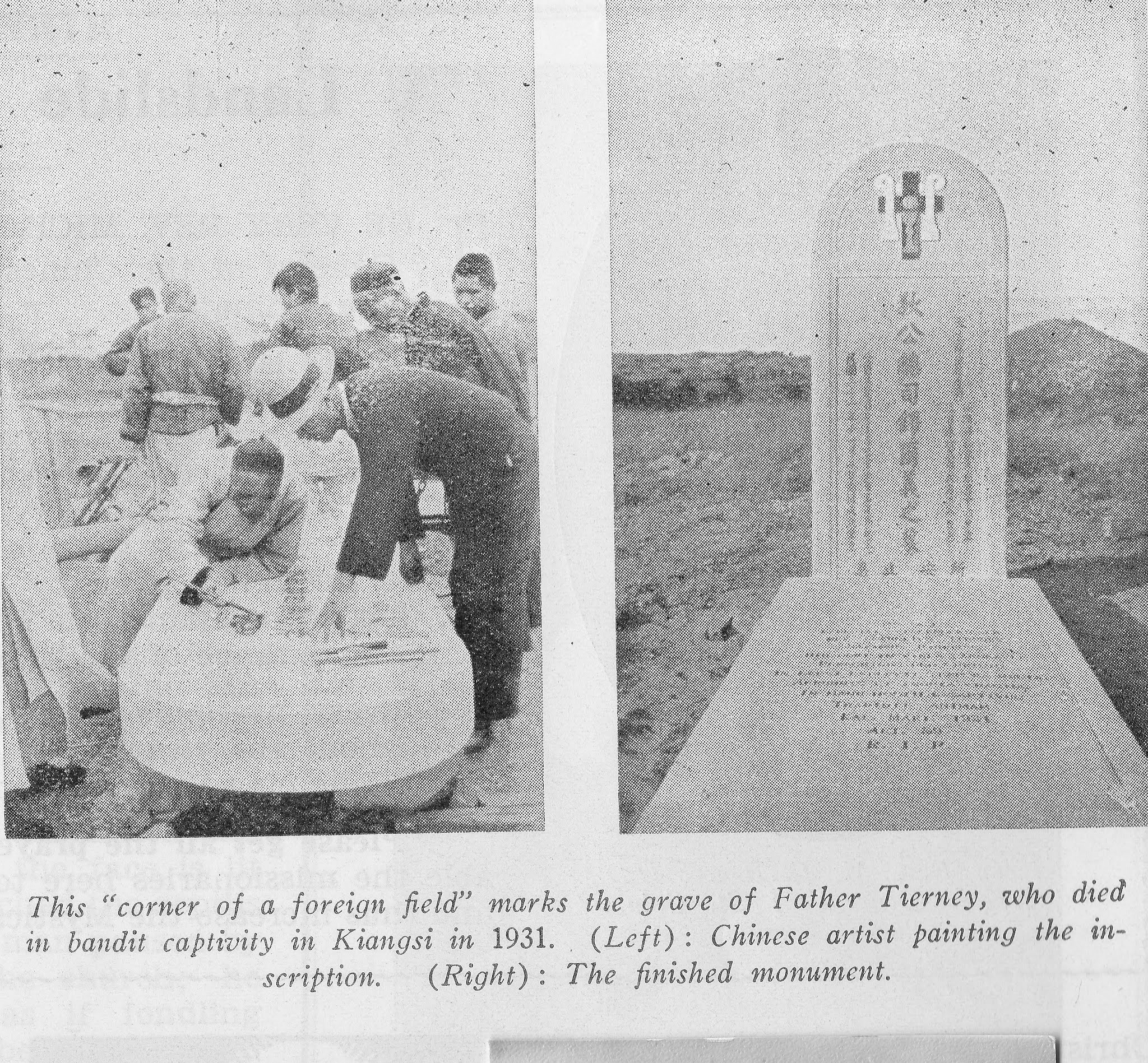
Many years ago a neighbour of mine Brigid Kelly told me that she attended a mass for Fr. Tierney on Wednesday 15th April 1931and that there was a black coffin in the chapel. She had a very keen memory and recalled this solemn event which had a draped coffin in front of the High Altar. This was the first time I had ever heard of a coffin in the chapel with no remains although it may have been familiar to other people. She recalled that there was an air of great sadness in the church and no doubt the coffin in front of the altar added to the touching scene with many in tears. Canon McGrath P.P. Bundoran celebrated the Mass and Monsignor Tierney P.P. Enniskillen presided at the Solemn Office for the Dead with Fr. Timoney from St. Joseph’s as one of the chanters. There were upwards of 40 priests in attendance and some businesses in the town were closed to give employees an opportunity of showing solidarity with this martyred priest. Fr. Tierney is buried in China. 
The  people of Ballyshannon and many from Bundoran, Belleek and outlying districts packed St. Joseph’s Church for a requiem mass in his memory. Fr. Tierney as some will know served in this chapel from 1911-1917 and was very popular with the parishioners many of whom were at this special ceremony. 
Fr. Tierney G.A.A Park in Ballyshannon in memory of this martyred priest.


On the 18th February I posted a blog available in the blog archive at the side of this blog which attracted lots of interest . “From Ballyshannon to China a never forgotten event” told the story of Fr. Tierney who was a priest in the Rock who volunteered to serve in China where he was killed 90 years ago in February 1931. He is buried there but the community in Ballyshannon decided to have a Requiem Mass with a difference in his memory. 

St. Joseph's Church with the Fr. Tierney
Memorial  visible
inside the railing to the left of front door


Today he is remembered by the Aodh Ruadh club who named their football pitch after him and he is also remembered by a memorial at the entrance to St. Joseph’s Church which was erected by Fr. Munster who also served in St. Joseph’s church in recent years. For more information read the blog archive to the right of this article for 18th February 2021.


Memorial to Fr. Tierney in St. Joseph's Church


Limited edition quality hardback with dust jacket as above available in A Novel Idea and Local Hands Ballyshannon and Four Masters Bookshop Donegal Town. 
Also available signed copies, and inscriptions, for postage or collection from anthonyrbegley@hotmail.com

Topics include: How to go about Tracing your Roots/The first settlers in the area/ Newly researched history of the town of Ballyshannon and the townlands in Kilbarron and Mágh Éne parishes/ Records of the first travellers and tourists to Ballyshannon, Bundoran, Belleek, Rossnowlagh and Ballintra/An aerial guide to place names along the Erne from Ballyshannon to the Bar/Flora and Fauna of the area/  5  Members of Parliament from Ballyshannon/ A history of buildings and housing estates in the locality/Graveyard Inscriptions from the Abbey graveyard, St. Joseph’s and St. Anne’s /Rolling back the years with many memories of the Great Famine, Independence struggle, hydro-electric scheme, Gaelic games, boxing, handball, Boy Scouts, soccer, mummers, characters, organisations, folklore and lots more.

Wednesday, 17 March 2021

Ballyshannon Memories on St. Patrick's Day

Rag Tree at St. Patrick's  Well Ballyshannon

Happy St. Patrick's Day to those at home and away with  Ballyshannon connections or interests. Nostalgic memories today include customs and cures at St. Patrick's Well,  photos of the town band on St. Patrick's Day and remembering the man from California who gave St. Patrick's statue to our town. 

The present St. Patrick's Well in Ballyshannon was opened in 1929 although pilgrims had visited the site to worship for hundreds of years.

  
"Pray for the Donor" inscription on statue of
St. Patrick. Donor revealed below.

On St. Patrick’s Day 1932 the new statue to St. Patrick was blessed at the Abbey Well by Monsignor McGinley D.D. The statue was donated anonymously.  In 1940 the identity of the donor was revealed when Maurice P. Hayes died in that year at Santa Monica in California. His connection with the Ballyshannon area was through his friendship with William Meehan of Durnish Rossnowlagh and he had acted as executor of his will in 1905. Much later he met Fr. Griffith, a nephew of William Meehan, who was a curate in Ballyshannon. The Hayes family came on a trip to Ireland and met Fr. Griffith in Dublin where he told them of the development of the Abbey Well.  Maurice Hayes gave a gift of the statue of St. Patrick which still stands at the Abbey Well with the inscription; “Pray for the Donor.”


A station at Ballyshannon's St. Patrick's Well


The Stations at the Abbey Well
Patterns or festivals were celebrated in honour of the patron saint (patrún) of a district or of some saint associated with the area. The pattern at the Abbey Well was held on the Feast of the Assumption on the 15th August each year. It is possible this feast day was chosen because the nearby Abbey of Assaroe was dedicated to Mary. Patterns were important social occasions and, according to tradition, the pattern at the Abbey Well was attended by large crowds up to the nineteenth century with the religious and social events lasting for a few days.
On arrival at the Abbey Well, the pilgrims on some occasions would have Mass celebrated for them, but for the most part they would have performed the station. The station involved reciting set prayers and moving around beds in a similar manner to Lough Derg at the present time. According to folklore the station at the Abbey Well went as follows: Fifteen pebbles were picked from the river bed or station bed and pilgrims began by saying, one Our Father, one Hail Mary and one Creed while kneeling at the well. Then going sun wise they knelt at each bed, saying one Our Father, ten Hail Mary’s and one Creed. A pebble was tossed into each bed. The round of five beds was completed three times and the station was concluded by taking three sips of water from the well and saying a rosary at the grotto

Rag Tree at St. Patrick's Well
Despite the religious revival in the 1930s and 1940s,  large crowds visiting the Abbey Well gradually waned and nowadays visits to the well are infrequent, except on days like the 15th of August when people still carry on the tradition of visiting the well on the pattern day. 
A feature of the Abbey Well which still attracts great interest from visitors are the rags on the white thorn bushes. Wells were said to have certain cures attached to them and the Abbey Well water was said to be most beneficial for trouble of the eyes. Offerings of coins, medals, flowers and cloth are associated with wells in various parts of the country and the tradition is still practised at the Abbey Well. This tradition of pilgrims with illness or concerns, praying and leaving a piece of cloth on a bush, reminds us that in our modern world there are still echoes of a world which has not fully vanished.

Ballyshannon Brass and Reed Band at St. Patrick's Well in 1947
               Front (l.to r.) Cyril Curran, Leo Masterson (young boy), John McCafferty
                 Middle Row: Freddie McDonagh, Patsy O' Donnell, Sean Fox, Jim Dolan,
 P.J. Goan, Tom Gallagher, Jim Gallagher, Jimmy Daly.
                   Back Row: Bob Gallagher, Jim Gallagher, James Gallogley, Packie McIvor,
                              Jimmy McNulty, John Davy, Pat McGahern, Seamus Gallagher, Jimmy Coughlin.


Ballyshannon Band at Sligo Parade St. Patrick's ' Day 1979
        Front (l.to r.) Padraig McGarrigle, Danny McGeever, Seamus Gallagher, Bob Gallagher
       Second Row (l.to r.) Jack Grimes, Packie Gallagher, Jimmy Rafferty, Francis Gallagher,
Tom Gallagher, Anthony Begley, James Hoey
            Third Row (l.to r.) Mickie Gallagher, Fergus Lawlor, Michael Dalton, P.J. Goan, Jim Gallagher
   Fourth Row Eamon Gallagher, Cecil Stephens, Michael Gallagher, Eugene McLoughlin
John McGahern.
Band members at St. Patrick's Day Parade Donegal Town 2012
(l.to r.) Danny Carron, Anthony Begley, Tom Gallagher, Michael Donagher
                         Tom Gallagher is the longest serving member in the  history of the band.


Limited edition quality hardback with dust jacket as above available in A Novel Idea and Local Hands Ballyshannon and 
Four Masters Bookshop Donegal Town. 
Also available signed copies, and inscriptions, for postage or collection from anthonyrbegley@hotmail.com

Topics include: How to go about Tracing your Roots/The first settlers in the area/ Newly researched history of the town of Ballyshannon and the townlands in Kilbarron and Mágh Éne parishes/ Records of the first travellers and tourists to Ballyshannon, Bundoran, Belleek, Rossnowlagh and Ballintra/An aerial guide to place names along the Erne from Ballyshannon to the Bar/Flora and Fauna of the area/  5  Members of Parliament from Ballyshannon/ A history of buildings and housing estates in the locality/Graveyard Inscriptions from the Abbey graveyard, St. Joseph’s and St. Anne’s /Rolling back the years with many memories of the Great Famine, Independence struggle, hydro-electric scheme, Gaelic games, boxing, handball, Boy Scouts, soccer, mummers, characters, organisations, folklore and lots more.


Saturday, 27 February 2021

On this Day. From Ballyshannon to China a Never Forgotten Event

Fr. Tierney Park on the right , the Workhouse in the centre, and Munday's field on the left.

On this day, 28th February, 90 years ago, Ballyshannon was totally gripped by a story unfolding in far off China. This blog tells the story and has a very rare image with Ballyshannon links to an event in China still remembered in Ballyshannon today. 
The name of Fr. Tierney is still remembered by the Aodh Ruadh G.A.A. club in Ballyshannon who have named their main playing field in his memory. 
At St. Joseph’s Church nearby a commemorative stone records details of his life which was erected by Fr. Munster during his period as curate at St. Joseph's Church on the Rock. Inside the church is a photograph of Fr. Tierney and two framed newspaper articles from “The Donegal Vindicator”  which I donated recounting his  captivity in China. 

 • Fr.Cornelius Tierney was a native of Clones in Co. Monaghan. In 1911 he was appointed curate at St. Joseph’s Church on the Rock, where he was to serve until 1917. Fr. Tierney was the first priest to reside in the present parochial house which still stands above the football field. He was active in supporting Gaelic games and the Gaelic League. Fr. Tierney regularly gave Irish classes in the Rock Hall in the 1916 period
. • At the age of 45, Fr. Tierney had a strong urge to join the Maynooth Missions to China. After some soul searching he travelled to the Columban Mission House in Hangyang, Hupeh in China. He proceeded to learn the language and began the challenging work of spreading the Gospel.
 • Fr. Tierney paid a brief visit to Ballyshannon in 1927 and Bridget Kelly of West Rock, recalled his visit to the local primary school where she was a student. Her mother also told her that in his years as a curate on the Rock, Fr. Tierney was a familiar figure as he cycled to the homes of parishoners
 • On his return to China in 1928 he was put in charge of the mission at Kien Chang in Kiangsi. There was much unrest in China and Communist resistance was prevalent in Fr. Tierney’s region. Fr. Tierney wrote many letters during his years in China and his final letter, on the 1st November 1930, was to Dr. Mulhern, Bishop of Dromore, who had been parish priest in Bundoran with Fr. Tierney as his curate in St. Joseph’s Ballyshannon. He expressed concern about the unrest in China and indicated that the situation was difficult where he was. 

Fr. Tierney served in the Rock Church before
volunteering for China.
Fr. Tierney Captured and died in China
Two weeks after he wrote this letter Fr. Tierney was captured by Communists. His capture is recorded in a letter written by Fr. John Kerr from Kien Chang on Monday 24th November 1930: 

" He was captured on Friday morning, November 14th, at about 6 a.m. at my mission station, Shang Tang Hsu, about 50 li (17 miles) from Kien Chang. He had come to me, some days before, to oversee the building of a house for me, as previously I had been living in the sacristy. ------- The bandits arrived in the early hours of the morning, and lay outside the town to wait for dawn. When they heard the Catholic Church bell ring for Fr. Tierney’s mass they drew up and surrounded the place. At the last minute, a Catholic rushed in to tell the priest to fly. Fr. Tierney was just saying his prayers in preparation for mass. He jumped up from where he was kneeling, snatched his hat and rushed for the door. But it was too late: there was no escape. He was seized by two Communists just about ten yards from the door".
 • Fr. Tierney was held for ransom by the communists and he was treated harshly. During his captivity he was able to correspond with his colleagues in Latin. The final letter recorded from captivity was received in early December 1930 and in it he expressed thanks for medicines, bread, milk, coffee and clothes which his fellow priests had sent.
• According to reliable sources he was released from captivity but was recaptured by bandits. From fellow prisoners it was revealed that Fr. Tierney died on the evening of Saturday February 28th 1931 about 2 p.m. and was buried the same evening about 4 p.m. Finally after lengthy negotiations his remains were exhumed and brought to the city of Kien Chang (Maynooth Mission Headquarters, Province of Kiangsi). He was buried after High Mass on Wednesday 1st April 1931. 


Official Opening of Fr. Tierney Park 9th May 1954 
It was fitting that the Aodh Ruadh Club in Ballyshannon perpetuated the courage of this martyr priest by naming the Fr. Tierney Park in his memory. Fr. Tierney had been a great supporter of Gaelic Games and Irish culture. At the official opening, Canon Mc Quaid of Bundoran, assisted by Fr. Mc Elroy of St. Joseph’s Church blessed the new football field. The official opening saw a match between Donegal and Armagh with Donegal winning on a score line of 1-6 to 0-5.
 A Local   G.A.A. Anecdote
An interesting anecdote concerning Major Myles, a local businessman, and Fr. Tierney, curate on the Rock, occurred in 1914. Major Myles was walking up the Rock Road, prior to the outbreak of World War One, when he met Fr. Tierney near St. Joseph’s Church. Major Myles seemed to be in a melancholy mood and Fr. Tierney asked him what was bothering him. His reply was that he had enlisted in the army to fight in the First World War, and he feared that he might not return to Ballyshannon. Fr. Tierney assured him that he would be alright and years later when the local G.A.A club were building the Fr. Tierney Park, Major Myles subscribed generously to Mick Melly for the Park Development, no doubt remembering his conversation many years previously. 

Fr. Cornelius Tierney is not buried at St. Joseph’s but is interred in China where he died as a missionary priest spreading the gospel message. His memory will live on for generations of Gaelic football players in Fr. Tierney Park and for the local community at St. Joseph’s Church where his memorial is located.

Memorial to Fr. Tierney at St. Joseph's Church


Limited edition quality hardback with dust jacket as above available in A Novel Idea and Local Hands Ballyshannon and Four Masters Bookshop Donegal Town. 
Also available signed copies, and inscriptions, for postage or collection from anthonyrbegley@hotmail.com

Topics include: How to go about Tracing your Roots/The first settlers in the area/ Newly researched history of the town of Ballyshannon and the townlands in Kilbarron and Mágh Éne parishes/ Records of the first travellers and tourists to Ballyshannon, Bundoran, Belleek, Rossnowlagh and Ballintra/An aerial guide to place names along the Erne from Ballyshannon to the Bar/Flora and Fauna of the area/  5  Members of Parliament from Ballyshannon/ A history of buildings and housing estates in the locality/Graveyard Inscriptions from the Abbey graveyard, St. Joseph’s and St. Anne’s /Rolling back the years with many memories of the Great Famine, Independence struggle, hydro-electric scheme, Gaelic games, boxing, handball, Boy Scouts, soccer, mummers, characters, organisations, folklore and lots more.

Saturday, 20 February 2021

From Lover's Walk in Ballyshannon to The Fairy Bridges in Bundoran

This is a visual blog with 6  old local photos  but be prepared to be surprised.  The first image is of the beach in Bundoran  from a postcard in 1905 but have a close look at the second image which is supposed to be of  the same photo. They say the camera never lies but  can you spot changes in this and the other photos. In the Ballyshannon image Lover's Walk I believe was a movable location but perhaps someone can identify it?


Spot the differences in the 2 photos of the Fairy Bridges below.


Saturday, 13 February 2021

On this Day. Ballyshannon Remembers and Names 19 Girls shipped to Sydney Australia

Mr. Robert Owen- Jones of the Australian Embassy laying a wreath, on behalf of the Australian
   people, at the Orphan Girls Memorial in Ballyshannon along with local historian Anthony Begley. 

On this Day 13th February we remember and name 19 Orphan Girls aged 14-18 from Ballyshannon, Belleek Mulleek and Kinlough areas who were shipped to Australia. In these challenging times it is worth remembering these girls who faced enormous difficulties, but survived and contributed to Australian society. Can you help to find any relations in the areas above? The Australian Embassy in Dublin visited Ballyshannon to lay a wreath and thank the local community for remembering the girls . They are remembered at the Famine Orphan Girls Memorial, the only one of its kind in Ireland, beside the Workhouse in Ballyshannon. They landed in Sydney on this day 13th February.

Why were 19 girls shipped from Ballyshannon to Australia at the height of the Great Famine? A government scheme called the Earl Grey Scheme shipped 4,000 girls from Irish Workhouses to Australia to make up for a shortfall in Australia of female workers for domestic work and ultimately for marriage.
The 19 orphan girls had left Ballyshannon in November 1848 and made their way under supervision to Plymouth in England. There they joined up with some orphan girls from other Irish workhouses and made the long journey to Sydney in Australia on board a ship called “The Inchinnan.” The orphan girls landed in Sydney Harbour on 13th February 1849 after a journey of 106 days. 

19 Orphan girls from Ballyshannon landed in Sydney on 13th February and were placed in Hyde Park Barracks above.

Orphans from Ballyshannon workhouse, along with many of the others, were housed at the Female Immigrant Depot at Hyde Park Barracks at the top of Macquarie Street. The building had previously been a barracks for convicts and had been re-designated as an immigration depot. An orphan committee made up of various sections of the community in Sydney, were now responsible for the welfare of the girls, and they acted as a job placement agency where employers could come and  hire out the Ballyshannon girls. The girls would not have known anyone in Australia and were at the mercy of those who employed them.
Conditions of employment were set by the orphan committee with rates of pay defined by age, and in all cases, they were lower than the prevailing rate in Australia for female servants. This proved an added incentive to employers who had to be cleared by the orphan committee as being suitable employers for the girls. The committee could also give or withhold permission for an orphan to get married. 

Who were these girls and where were they from? Can you help?
 
The 19 girls were from The Ballyshannon area, Belleek and Mulleek areas in Fermanagh and Kinlough in Leitrim and were all inmates in Ballyshannon Workhouse. The girls from Ballyshannon below could be from any of the districts around the town.

Mary Allingham Belleek
Jane Carberry Ballyshannon
Jane Carleton Fermanagh
Ellen Feely Ballyshannon
Sally Lennon Belleek or Mulleek
Margaret  and Ann McBride sisters born in Ballyshannon and Belleek
Letitia and Mary McCrea sisters born in Ballyshannon and Fermanagh
Mary Ann and Sarah McDermott sisters Belleek and Ballyshannon 
Jane McGowan Kinlough
Mary McGowan Kinlough
Mary McGuire Mulleek Fermanagh
Ann Muldoon Mulleek fermanagh
Rose Reel U.S.A.
Ann Rooney Ballyshannon
Biddy Smith Ballyshannon
Margaret Sweeney Ballyshannon

Can you help? These girls would still have relatives in the areas listed above. Can you trace any connection? 
There have been lots of connections with relatives in Australia but so far none in the areas above. Further blogs will tell how the girls got on in Australia thanks to contacts with their descendants there.

Orphan Girls Memorial in Ballyshannon - the only one of its kind in Ireland 


Limited edition quality hardback with dust jacket as above available in A Novel Idea and Local Hands Ballyshannon and Four Masters Bookshop Donegal Town. 
Also available signed copies, and inscriptions, for postage or collection from anthonyrbegley@hotmail.com

Topics include: How to go about Tracing your Roots/The first settlers in the area/ Newly researched history of the town of Ballyshannon and the townlands in Kilbarron and Mágh Éne parishes/ Records of the first travellers and tourists to Ballyshannon, Bundoran, Belleek, Rossnowlagh and Ballintra/An aerial guide to place names along the Erne from Ballyshannon to the Bar/Flora and Fauna of the area/  5  Members of Parliament from Ballyshannon/ A history of buildings and housing estates in the locality/Graveyard Inscriptions from the Abbey graveyard, St. Joseph’s and St. Anne’s /Rolling back the years with many memories of the Great Famine, Independence struggle, hydro-electric scheme, Gaelic games, boxing, handball, Boy Scouts, soccer, mummers, characters, organisations, folklore and lots more.


Saturday, 12 December 2020

Ballyshannon's Greatest Pioneer and the First Motor Car in Town


The first car registered in Ballyshannon in 1905 was a De Dion 6 h.p. car like this one 

The first man to register a car in Ballyshannon was probably the greatest pioneer that Ballyshannon has produced and you can read in today's blog  about his many achievements and his wonderful cars. The number plate of his 1905 car was IH 19. In 1922 and 1923 he registered two other  cars with the same number plate which must have been a real talking point in Ballyshannon a hundred years ago. Check out  stylish photographs of his 3 early cars, his pioneering story and a beautiful view of his home in Ballyshannon which is still occupied today.

A Local book for Christmas 2020 See details at
the end of this blog

The first car  registered in 1905 in Ballyshannon was by James Sproule Myles West Port Ballyshannon.  This  was a 6 h.p. De Dion motor car painted white and with the wheels painted red similar to  the one pictured above. This certainly cut quite a dash in Ballyshannon over 100 years ago. Major Myles as he became is probably Ballyshannon's greatest pioneer

  • Major James Sproule Myles is remembered as he introduced electricity to Ballyshannon and Bundoran from 1908. and he worked at erecting the poles. 
  • His military title dated to the First World War when he was awarded a bravery medal at the Battle of the Somme. 
  • He was elected an independent T.D. in  Dail Éireann from 1922-1943. 
  •  He also served on the Town Commissioners, Fishery Board and was on Donegal County Council for over 30 years.
  •  Sproule Myles  played international rugby for Ireland and was a member of the first Irish team to play in Canada in 1899. 
  •  He was also a swimming champion in the North-West region.
  •  J.S. Myles played an active role in the retention of the Rock Hospital and in the establishment of the first Technical School in County Donegal in Ballyshannon in 1914.


A 17.4 Overland 4 seater Touring Car  like this was registered by Major Myles in October 1922. He kept the same number plate as before IH 19.

  • Major Myles was in every way a community leader and when Donegal County Council introduced the first steam roller into Ballyshannon it was Major Myles who taught the men how to drive it.
  • He also played a major role in establishing the first fire brigade in Ballyshannon during the Emergency 1939-1945. 
  • He was also active with the Red Cross and the ambulance. 
  • His family had their own ships importing coal, timber etc. into Ballyshannon and he was an expert pilot in guiding the ships safely into the Mall Quay. 

In  May 1923 Major Myles registered a Crossley Blue motor car like the one in the image.

Major Myles died on 13th February 1956 and is buried at St. Anne's in Ballyshannon. (See "Ballyshannon Genealogy and History" book  for all inscriptions on gravestones in this cemetery. All inscriptions for St. Joseph's and Abbey Assaroe are also in the book). 

The shell of the Myles commercial buildings can be seen at  Milltown on the Bundoran road and can also be viewed from the Mall Quay  today. This property was sold 50 years ago by John Myles the last of the family in business in the town. Major Myles' home called "Inis Saimer" overlooks the island of the same name and is the family home of Aiden and Sharon McGuinness today.

Inis Saimer island  (left) and "Inis Saimer" house, former home of Major Myles, in the centre of photo overlooking the island. Photograph taken from the Mall Park in the Autumn of 2020.

Ballyshannon at Christmas 2020 courtesy of Ballyshannon Business Chamber

For more on Major Myles' life check out "Ballyshannon Genealogy and History" below. 


Ideal Local gift for Christmas home and away. Limited edition quality hardback with dust jacket as above available in A Novel Idea and Local Hands Ballyshannon and Four Masters Bookshop Donegal Town. 
Also available signed copies, and inscriptions, for postage or collection from anthonyrbegley@hotmail.com

Topics include: How to go about Tracing your Roots/The first settlers in the area/ Newly researched history of the town of Ballyshannon and the townlands in Kilbarron and Mágh Éne parishes/ Records of the first travellers and tourists to Ballyshannon, Bundoran, Belleek, Rossnowlagh and Ballintra/An aerial guide to place names along the Erne from Ballyshannon to the Bar/Flora and Fauna of the area/  5  Members of Parliament from Ballyshannon/ A history of buildings and housing estates in the locality/Graveyard Inscriptions from the Abbey graveyard, St. Joseph’s and St. Anne’s /Rolling back the years with many memories of the Great Famine, Independence struggle, hydro-electric scheme, Gaelic games, boxing, handball, Boy Scouts, soccer, mummers, characters, organisations, folklore and lots more.


Saturday, 5 December 2020

The Life and Times of a Civilian Shot in Ballyshannon during The War of Independence on this Day

The scene of the shooting of Tommy Rooney at East Port Ballyshannon on December 5th  1920. The badly wounded man reached the Kane home, down the street, on the left of where the cyclist is, where he died from his wounds. 

On this day 5th December 2020 remembering the life and times of Tommy Rooney the first civilian shot in Ballyshannon during the War of Independence 100 years ago today. The article, with new research, which I have written in this blog below was also printed in The Donegal Democrat on Thursday 3rd December 2020 where it gave great coverage to Tommy Rooney, one of its former employees. If you know anyone who is interested and is not on the internet they can pick up a copy of the paper. More material on this and The War of Independence can be found in the book Ballyshannon Genealogy and History a local book for Christmas.

A local book for Christmas for those at  home or  away.
See details at end of blog.


One hundred years ago on the 5th December 1920, Thomas (Tommy) Rooney, a compositor with “The Donegal Democrat,” was shot by a British soldier at East Port Ballyshannon. Tommy was born in Govan, Lanarkshire, Scotland on 31st May 1896, the son of Thomas and Elizabeth (Eliza, Lizzie) Rooney who had married in Ballyshannon in 1893. By 1899 the family were back living at West Rock in Ballyshannon and they had 5 sons, Patrick, Thomas, James, Michael, John and one daughter, Mary Josephine, who died in her early childhood. Tommy’s 4 brothers were all born in Ballyshannon. After Tommy Rooney left school he worked as a compositor with “The Donegal Independent” a Ballyshannon newspaper which pre-dated “The Donegal Democrat.” 

He enlisted in the 5th Battalion, Royal Irish Rifles, as private 22432 on 15th April 1918 but he did not have active service in World War One due to ill-health. He was discharged from the army on 9th August 1919 and was awarded the Silver War Badge which was granted to army personnel who had been honourably discharged due to sickness or wounds. His commanding officer wrote of him; “A very good man who answered his Country’s call, is discharged in consequence of ill health”. 

On his return to Ballyshannon Tommy found employment as a compositor in “The Donegal Democrat” which began publication on 16th June 1919. 

Ballyshannon for the most part had been relatively quiet in the War of Independence with attacks on the Customs Office, the RIC Barracks and a curfew at the Harvest Fair in 1920. Tensions in the community were increased by British military from Finner Camp raiding numerous family homes in the town, where nothing incriminating was found. On Friday 3rd December three men from the East Port area of the town were arrested and were interned in Ballykinlair Camp in County Down, with men from different parts of the country, including men lifted after Bloody Sunday in Dublin a few weeks previously. Those arrested and interned without trial were Seamus Ward of The Bridge End Bar (now McGraths), a County Councillor, and a member of Ballyshannon Town Commissioners, John Kane also a Town Commissioner and F.H. Morgan, a prominent business man in East Port. The following night Saturday 4th December there were a lot of men on the streets at East and West Port and the Bridge End but, according to the military, local people and the local newspapers there was no civil unrest.
  Margaret Kane East Port who tended to the dying Tommy Rooney
     in her home. her husband John was one of 3 local men interned 
in Ballykinlair internment camp. (Photo courtesy of Phyllis Kane)

The Shooting of Tommy Rooney 
Very early on Sunday 5th of December 1920 Tommy Rooney, who had no background in politics,was shot dead by a British military patrol in East Port. A Military Court of Inquiry was held very quickly the following day, Monday 6th December, in the Boardroom of the Ballyshannon Workhouse to investigate the circumstances surrounding the death. The Court consisted of three military officers who had viewed the body in the Workhouse morgue beforehand. The family had no legal representation at the Inquiry. People who attended the tribunal included Tommy Rooney’s father, Dr. Gordon and evidence was given by Mrs. Margaret Kane, a local man who was at the scene, also a Lieutenant in charge of the military patrol, a police sergeant, the private army soldier who fired the fatal shot and another private soldier. 

Thomas Rooney (senior) of West Rock Ballyshannon had the sad duty of identifying his son’s body and later informed the inquiry that his son was twenty five years of age and had been a soldier in the Irish Rifles in World War 1. His record showed that he had served honourably and his discharge sheet showed that he was trustworthy and could be recommended to any employer. His son worked for Cecil Stephens and John Downey (founders) in printing works which were the premises of “The Donegal Democrat” in the centre of town. He informed the tribunal that his son had taken no part in any political disturbances in Ballyshannon and never was involved with any civil unrest. Dr. Gordon advised the tribunal that Tommy Rooney had been shot once and that death was most probably due to haemmoraging. 

Mrs. Kane said that she had been sitting by the fire in her home in East Port when she heard two shots ringing out. As she went to lock the front door, Tommy Rooney pushed it in. It was about 12.10-12.15 a.m. on Sunday 5th December. Deceased said, “Mrs. Kane, I’m shot. ” He fell in her hallway and asked her to get a priest. She wasn’t able to do this because of the dangerous situation on the street but she did get word by the back way to his aunt, Mrs. Fannon, who lived nearby. Tommy Rooney was in a weakened state and was not fit to tell her how the incident had happened. Like all other accounts she told the tribunal that the street had been quiet before she heard the shooting.

A local man gave evidence that he saw Tommy Rooney on the street but that he was not speaking to him. He was challenged by a patrol and put his hands up. Tommy Rooney went in the direction of John Kane’s house. Witness said that he heard three shots ring out but that prior to the shooting the area had been quiet. A Military Lieutenant told the Inquiry that he was on patrol with four soldiers in the East Port area, early on Sunday morning, and challenged and searched a group of 20 civilians who were coming from the direction of the bridge. He found no weapons and allowed them to proceed, however he stated that he saw two men in a doorway, one tall and one smaller men. He challenged them and the taller man at once put his hands up. He was in the process of searching the taller man when he heard a noise and saw the smaller man twisting away from the patrol. A soldier told the inquiry that he called on the man to halt, but when he did not stop, he opened fire but couldn’t indicate to the tribunal if he had hit him and could not identify the body. Another private soldier told the tribunal that he was part of the patrol and that a soldier raised his bayonet to challenge the smaller man but the man ran down East Port. He stated that the soldier fired a shot which hit the civilian who doubled up after the shot was fired. That was how he knew that he was hit but the civilian kept on running and disappeared into the darkness. Although Tommy Rooney had been accepted into the army, he was, surprisingly only over 5 foot and was the smaller man who was shot and who left a trail of blood on East Port down as far as Kane’s house. 

A police sergeant gave evidence that he was in charge of a patrol from 12.00 to 3.00 a.m and that he heard a report of firearms about 12.15. About 12.45 he saw a number of civilians and there was more activity than normal considering the late hour. His police patrol met a lieutenant and a military patrol on the bridge at Ballyshannon. The military told him that that they had occasion to fire a shot or two in East Port. The police officer stated that he asked were there any casualties and he was informed that only a soldier had grazed his finger. He stated that that there were two shots fired within ten or 15 seconds of each other and that he heard a third shot about 3 a.m. The police officer had not heard that Tommy Rooney had been shot at this period. 

The tribunal concluded as follows: “That court having carefully considered the evidence are of the opinion that the deceased, Tommy Rooney:
 a) Met his death from a bullet wound on December 5th 1920, in Ballyshannon.
 b) That the bullet which caused the death of Thomas Rooney, junior, was fired by the military in the execution of their duty.
 c) That no blame attaches to any person other than the deceased for his death”. 

An early newspaper account gave a conflicting account of what had happened. “From the meagre details to hand, it is not clearly known how the tragedy occurred, but some people state that the deceased failed to answer the challenge of “Hands up” while others say there was no challenge issued. The remains were removed to the Workhouse Morgue on Sunday pending an inquiry. Deceased was not a Sinn Feiner and was not in any way identified with politics.”
The military court of inquiry into Tommy Rooney's death was held  
upstairs in this workhouse building which still stands today.

The remains of Tommy Rooney were removed to St. Joseph’s Church on Monday evening 6th December and Requiem Mass was celebrated the following morning by Rev. J. Trainor. The funeral was attended by a large crowd of people and on Tuesday afternoon at 2.30 p.m. Fr. Trainor officiated at the graveside. Chief mourners were; Thomas Rooney (father), Paddy, James and John Rooney (brothers) and Richard Bromley (stepbrother). Funeral arrangements were by Edward Stephens, undertaker, and two wreaths were sent by the Comrades of the Great War in recognition of his army service. The list of mourners above included Richard Bromley whose father Herbert Bromley had died and whose mother Eliza subsequently married Thomas Rooney (senior).

 A grandson of Richard Bromley is John Bromley who coincidentally had a long association with “The Donegal Democrat” and was editor of the paper from 1988-2002. John Rooney followed in the newspaper business and worked as a printer with “ The Irish Press” and successive generations of the Rooney family have worked in the printing business. The Rooney grave is in the graveyard adjoining St. Joseph’s Church where Tommy Rooney and members of the family from Ballyshannon and Bundoran are buried. Michael (Mickey) Rooney St. Brigid’s Terrace Bundoran, died on 28th January 2017 and is interred in this family grave.
The grave can be identified and located as grave number 201 in Ballyshannon Genealogy and History which lists all the inscriptions in this graveyard.


Concerns over the Inquiry 
Edward Kelly M.P. a native of Ballyshannon, expressed concern in the Westminster Parliament that in the case of military inquiries, a solicitor for the next of kin should be allowed to appear as at normal inquests. His appeal in parliament on 25th November 1920, before the shooting of Tommy Rooney, was turned down but it highlighted the anxiety felt by families, at the verdicts of military inquests where they had no representation. The impartiality of the military carrying out the investigation into the shooting of Tommy Rooney, which involved one of their own soldiers, was to say the least open to question. The speed with which the inquiry was concluded, a day after the shooting, while people were still coming to terms with the shock of what had happened, left little room for reflection at the time. Edward Kelly M.P. who felt that families should have legal representation at military inquiries, was the last Donegal elected member of parliament to sit in Westminster and represented East Donegal. He was born and grew up on the Mall in Ballyshannon, in the impressive house that is now a shell and is known locally as Condons as they were the last family to live there.  
      The former home of Edward Kelly M.P. last member of parliament
for Donegal to sit in  Westminster.

“The Donegal Democrat” for which Tommy Rooney worked, reported that Mrs. Margtaret Kane had made an Act of Contrition and that the dying Tommy Rooney had repeated the words after her. Mrs. Kane had a most difficult few days, as her husband John was one of the 3 men arrested, on Friday 3rd December, and sent to Ballykinlair internment camp and she also witnessed the death of Tommy Rooney in her home, early on Sunday 5th December. 

John Downey, editor of “The Donegal Democrat,” knew the deceased well as a work colleague and he recorded that Tommy Rooney was “as harmless as a baby and a born humourist. He saw a joke in everything and laughed and his laughter was infectious. The question was asked at the Military Tribunal was he concerned in politics? No he wasn’t. He treated politics as he did many other things as a huge joke.” John Downey’s opinions about Tommy Rooney’s character, was echoed by Ballyshannon’s other newspaper “The Donegal Vindicator” which was located in East Port, beside where Tommy Rooney was shot.

 This shooting was the subject of debate and speculation in the town and it is worth noting that none of the civilians present at the time of the shooting had weapons or were engaged in disturbances. With the passage of time this event faded in memory but as the centenary approaches on the 5th December 2020, it is fitting to remember what was the first tragic shooting of a civilian in the town of Ballyshannon during the War of Independence . Further local events in The War of Independence can be found in “Ballyshannon Genealogy and History”


Ideal Local gift for Christmas home and away. Limited edition quality hardback with dust jacket as above available in A Novel Idea and Local Hands Ballyshannon and Four Masters Bookshop Donegal Town. 
Also available signed copies, and inscriptions, for postage or collection from anthonyrbegley@hotmail.com

Topics include: How to go about Tracing your Roots/The first settlers in the area/ Newly researched history of the town of Ballyshannon and the townlands in Kilbarron and Mágh Éne parishes/ Records of the first travellers and tourists to Ballyshannon, Bundoran, Belleek, Rossnowlagh and Ballintra/An aerial guide to place names along the Erne from Ballyshannon to the Bar/Flora and Fauna of the area/  5  Members of Parliament from Ballyshannon/ A history of buildings and housing estates in the locality/Graveyard Inscriptions from the Abbey graveyard, St. Joseph’s and St. Anne’s /Rolling back the years with many memories of the Great Famine, Independence struggle, hydro-electric scheme, Gaelic games, boxing, handball, Boy Scouts, soccer, mummers, characters, organisations, folklore and lots more.